

We, as food lovers, have weathered a number of storms in the past decade, involving crazy ideas for baked goods. Remember the Cronut? The Wonut? I think it’s time to reach into the ‘retro’ bag and pull out something just as novel, but much nicer – and REAL…
 The Cronut was a mashup of a crois-sante and a doughnut. Likewise, the Wonut was the supposed love child of waffle and a doughnut. There were lots of other even less-memorable mashups and crossovers over the years, all at-tempting to create something new which would hopefully go viral – and which the competition didn’t have…
Alas (but predictably) most of those efforts had their viral day in the social media sun, but disappeared as quickly as they had emerged.
A better strategy
I think a better strategy would have been to reach into the retro bag, and better yet, go international to find a classic treat that wasn’t yet well known in the West. But would appeal to main-stream tastes and whisper connections to already familiar foods. Which is ex-actly what we’re doing today…
A renowned Latino baker
Mely Martinez is a renowned Mexican baker and cookbook author. (See photo, top of page.) And one of her greatest accomplishments may be introducing a classic from her culture to the rest of the world. I speak of none other the Mexican Concha.
It’s beloved in Martinez’s home place, and she has absorbed tons of Concha knowledge and lore over her years as a culinary guiding light. Her post on Concha-making is a master class on the subject.
So… What is a Concha?
“Among all the different kinds of traditional Mexican Pan Dulce (“sweet bread”), Conchas are without a doubt the most popular and recognizable. No other pan dulce is more representative of Mexico and its love of bread,” Martinez enthuses. “With this authentic concha recipe, you will become familiar with how conchas are made and learn how to bake them in your own kitchen!”
Why ‘Concha?’
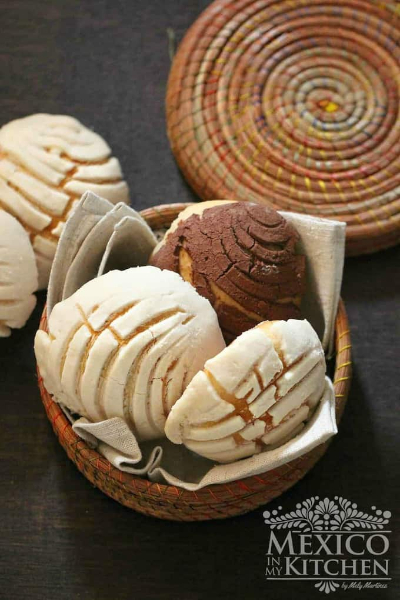
“Conchas are a soft and sweet Mexican bread with a white topping that resembles the surface of a seashell. This is where the concha gets its name, since ‘concha’ means ‘shell’ in Spanish. The classic color of the topping is white, but it can also be pink, yellow, or brown (which is chocolate flavored).”
Martinez explains, the Concha is the Mexican culture’s equivalent of a doughnut. And folks of ‘all walks’ eat them the same way, with the same joyful gusto.
You can see what Conchas look like in Martinez’s photo, above. But the flavour and texture must be experienced to be fully appreciated. As far as it can be put into words, Martinez describes it as ‘sweet, soft and airy’.
What you do
While the recipe is somewhat lengthy as far as prep time goes, it calls for only a moderate number of ingredients. And most will already be present in your well-stocked pantry.
The procedure is really like making any other kind of sweet dough, with a few key recommendations…
First, Martinez says you must use bread flour to achieve the right combination of density and airiness in your Conchas.
The other big MUST is to use butter – preferably unsalted – rather than any other fat. Only butter will produce the classic Concha flavour and texture.
Tempting Toppings
The topping on your concha is as important as the bun that’s underneath. There are as many differ-ent toppings as there are bakers who make Conchas. But the classics are vanilla and chocolate.
Martinez includes a Chocolate Topping recipe in her post that will sound suspiciously similar to our familiar butter cream icing. But the addition of both cocoa and cinnamon (those ancient and auth-entic Mexican flavour buddies) makes it special – even a little exotic. You may decide you like it so much, you’ll start adding cinnamon to all your coca-based baking projects…
Hint: The topping recipe calls for vegetable shortening. Any Non-Mexican baker worth their salt will reflexively flinch at that suggestion. You’re supposed to use only butter in butter cream! But shorten-ing is the classic, traditional Mexican ingredient in this application.
My take
The Concha may be the ‘Mexican Doughnut’, but it has many advantages, both in ease of prep and relative healthiness, over the conventional doughnut that I can see it eclipsing the standard sinker over time. If it only catches on in the Western culinary mainstream!
Now, I’ve done my part to spread the word…
~ Maggie J.