
A major Canadian dairy company has decided to offer a new form of milk, based on consumer demand. Sealtest is now selling ‘6%’ milk in the Ontario region, where perceived demand is greatest. But what is this stuff?
 What is 6% milk?
Not found in nature
If you thought there was something that just didn’t sound right about the notion of ‘6%’ milk, you were right. It is not a form of milk found in nature. But it turns out that’s not so unusual.
Think about it…
‘Whole Milk’ is 3.5 percent butterfat, with the milk solids and nutrients associated with that concentration. But we also have 2 percent milk, which has less fat and correspondingly less of the other stuff. And then there’s Skimmed Milk, which customarily clocks in at 1 percent fat.
We can forgive the kid who asked his parents, “Do they have special cows that give the different milks?” The answer, of course, is, “No.”
How they ‘make’ it
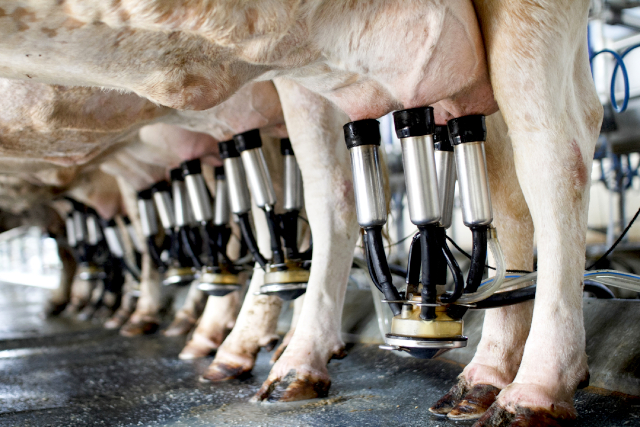
Modern dairies, which provide a wide range of products actually separate raw milk into cream and ‘skimmed’. Basic cream can top out as high as 40 percent butterfat. Skimmed, as we already noted, comes out at a maximum 1 percent. To produce the other concentrations of milk and cream, the dairies add back cream to skim in appropriate proportions to achieve the desired fat content.
Thus are we regaled, in the supermarket dairy case, with all three common grades of milk, plus Standard Cream (10 percent), Half-And-Half – AKA Table Cream or Coffee Cream – (18 percent), Whipping Cream (32% to 36%) and Heavy Cream (36% – 40%).
What’s the attraction?
So… 6% milk is easy for Dairies to ‘make’. But what’s the attraction?
One Québec-based dairy chain, Agropur, Canada’s largest dairy cooperative, says it’s customers are asking for 6% milk. They say there’s a solid demand for it in the South Asian Community
Indian dairy cooperative Amul has long offered a 6% option. It’s come into the Canadian market in the past few years after perceiving the same consumer interest. Amul’s products are already available in selected Canadian stores.
Superior functionality
And here, we’re talking not about the sense of ‘functional’ associated with protein- and fibre-enhanced foods. We’re talking how well milk performs in applications such as yogurt, as well as ricotta and paneer cheeses.
Some folks of Asian extraction simply love to drink more-concentrated milk. “Being an Indian person, we are the milk people. We love milk,” says Anika Dhalla, a Hamilton-based registered dietitian. “I definitely have patients who love milk as well just because I do work with a lot of South Asians. It’s a big part of the diet.”
However… Dhalla notes that 6% milk is no better or worse for you than regular 3.5% or even 2% milk. “It’s about preference.” she says. “If someone’s choosing higher fat, I usually question why.” Dhalla points out that 6% milk is also correspondingly high in fat, which may be contra-indicated for folks on certain diets.
My take
I’ve never found a need for any grade of milk or cream that isn’t already commonly provided at my local go-to supermarket. When I make Asian dishes – particularly wonderful, thick, creamy Indian and Southeast Asian curries, I use standard 10% cream. It’s never let me down!
But I can see how some folks of Asian extraction might feel more comfortable if they can get the 6% milk they’re used to. Although… They could simply mix 3.5% milk and 10% cream to get the flavour and consistency they’re looking for…
~ Maggie J.