
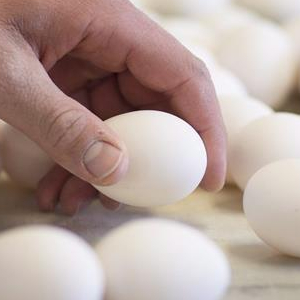
I guess it’s characteristic of social media… That one intriguing post will spawn a spate of similar ones. So it has been with egg hacks lately. Submitted for your approval: a genius ‘creamy’ scrambled egg tip you never saw coming…
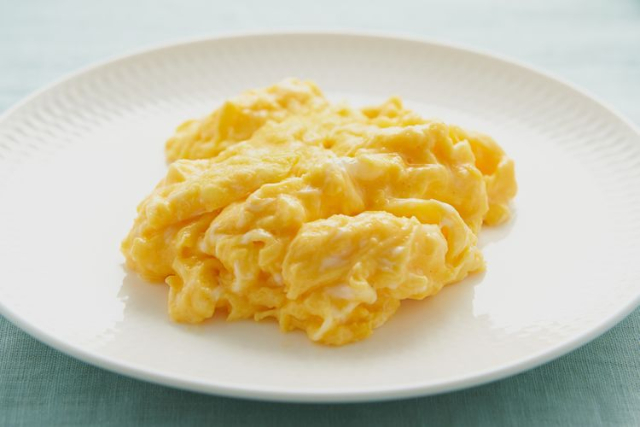 Do you like your Scrambled Eggs to look like this? I usually make mine drier – crumblier.
But that’s because I haven’t had a reliable hack for superior ‘creamy’ scrambles.
Simple yet effective…
Simply Recipes contributor Frank Tu has been kind enough to share his Chinese chef-Dad’s secret for creamy, always-moist scrambled eggs. And I have to admit, it’s just as simple and foolproof as Frank claims!
“For the longest time, I thought it was all technique,” Frank confesses. “While that might be part of it, my dad’s perfect eggs are also attributed to one simple addition: cornstarch. He uses this technique for his Cantonese shrimp and egg stir-fry, and I just can’t get enough.”
Here’s the deal…
I’m with Frank when he tells us he couldn’t figure out how cornstarch could deliver the results it does with scrambled eggs. And like Frank, I’ll admit, I associate cornstarch with thickening soups and sauces, and Asian breading techniques. But as I absorbed Frank’s analysis, all became clear…
“Eggs firm up when their proteins tighten with heat, so adding a small amount of cornstarch and water (known as a slurry) interferes with that process. The slurry slows down how quickly the eggs set, and it helps retain moisture, so the curds stay soft. The result is a scramble that’s smooth, tender, and slightly jiggly in the best way.”
Of course!
How to do it…
There’s a specific procedure to follow when adding cornstarch to eggs. And Frank has perfected it…
The slurry (for two servings of scrambled eggs) should consist of a level teaspoon of cornstarch mixed with one tablespoon of cold water. Make sure it’s COLD water; the starch will never blend with hot water. It’s like putting raw flour into hit pan drippings: Your gravy will probably curdle. Beat your starch-and-water mixture with a fork until the starch is fully dissolved.
In a separate bowl, beat 4-5 eggs until the yolks and whites are completely combined (no streaks). Then pour the slurry into the eggs while whisking the mixture.
“Heat a lightly oiled pan over medium” Frank continues. “Pour in the eggs and let them sit for a few seconds, just until the edges begin to set, then gently push the eggs to one side with a spatula, al-lowing the uncooked egg to flow into the pan. Repeat this process, moving slowly and deliberately, until the eggs are mostly set but still glossy.”
Big finish…
“At that point, take the pan off the heat and let the residual warmth finish cooking the eggs.” This final step is key, Frank stresses: “It keeps the eggs from overcooking and helps create a soft, silky texture.”
My take
I’ve been using slurries for decades to thicken sauces, soups and other creamy dishes. I’ve also been all too aware of the ‘cold water’ rule for mixing slurries for a very long time. And I hasten to add to Frank’s instructions, that slurries can be made from almost any starch. Arrowroot is big in Asia. Pota-to starch, likewise. And a slurry is the ideal technique to employ to ensure that your gravy never clumps!
But adding cornstarch to eggs was a completely new one on me. I’m just glad I paused my compulsive clicking long enough to see what Frank’s post was all about!
~ Maggie J.