
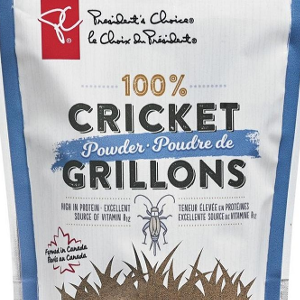
A bold Canadian startup sunk millions into a huge facility near London, Ontario a few years back. It was to be the world’s largest cricket farm. But it foundered on tech problems and ‘The Yuk’ Factor. What would it take to get you to start using insect-sourced protein?
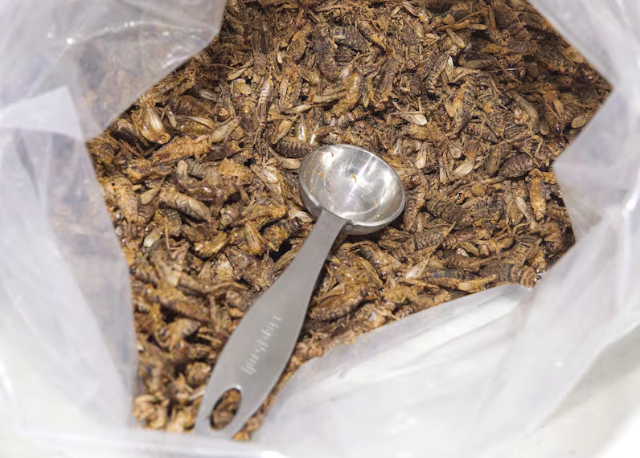 Dried Crickets: Before processing and packaging…
The mega-bug project undertaken by Aspire Food Group was supposed to be the start of something even bigger: a global insect protein revolution. But the highly-automated plan never really got up and running, due to technoloigcal problems. And the product was not widely taken up by consumers.
Promising prospects
The Asipre project has an auspicious start. The company won the prestigious $1-million US Hult Prize, given annually for ‘the idea most likely to change the world’. At that point, it was clearly, ‘Go big or go home’. And that attracted a host of big investors. The Canadian Government even invested a consid-erable sum.
Aspire’s facility opened officially in 2022. And closed in 2024.
Technology issues
The 150,000-square-foot hatchery was to be the world’s largest facility for raising crickets to be used as food – for animals and humans. Its custom-designed automated systems were supposed to mini-mize the need for ‘human intervention’ in the process. But the machines never worked reliably or in concert with one another. The plant never operated at over 50 percent of its designed capacity.
Aspire actually started as a very small operation, making cricket protein largely for use as animal feed. That process was much more human-intensive. It was also much more successful financially.
‘The Yuk Factor’
Consumers didn’t flock to the new products Aspire was trying to sell. All were based on its primary output: powdered cricket protein.
The Aspire team must have thought the time was right for cricket protein for human consumption. The Hult Prize might have started visions of sugarplums dancing in their corporate head…
After all, the mainstream and social media were alive with chatter about protein sources to replace conventional animal sources. How meat, as such, would largely disappear soon as it became more and more unsustainable. And thousands of vendors all over the world were already selling plant-based protein products ranging from supplements for body builders to flour.
But the so-called ‘Yuk factor’ prevailed in the end.
My take
The Aspire folks were definitely on the right track. But they were definitely at least a couple of decades ahead of their idea’s time. High-grade, concentrated insect-source protein products will come into our diets in a big way. Probably first as animal foods. Then as ingredients in commercial, factory-made food products. And finally in our own kitchen. But when that might be remains to be seen…
My questions to you…
Have you tried any insect-source foods?
If not…
Would you buy hem if you saw them in the store?
Would you try them if they were offered to you free, as a home taste tester?
Or would the ‘Yuk Factor’ keep you out of the game?
Given that non-animal sources will eventually become our main source protein…
Would you consider switching to conventional (vegetarian) sources such as Soy, Beans, Lentils or Quinoa?
Would you consider trying yeast, seaweed or other more-exotic veggie proteins?
And…
What would it take to get you to finally embrace insect-based protein products?
Muse on that!
~ Maggie J.