
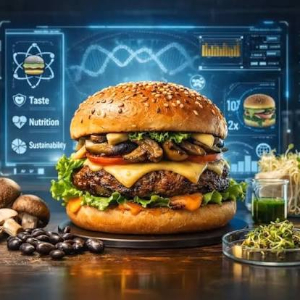
A team at Stanford University recently challenged its new AI system to study burger recipes and come up with the ultimate ‘formula’. What happened clearly points the way to how AI can and, perhaps, should be used…

There’s an old saying among computer programmers: ‘Garbage in, garbage out’. And that could de-scribe what’s been going on in AI development circles for the past few years. The brain trusts behind newer AI systems have been concentrating on maximizing what their ‘platforms’ and ‘algorithms’ can do. But maybe they should be focusing instead on the scope of the tasks they set their systems…
Focus on the task
A recent experiment by developers at Stanford University – perhaps unwittingly – points the way to how AI should be used.
Horror stories about AI running wild and triggering havoc have ruled the mainstream and social med-ia for years. In fact, Science Fiction writers have been warning us for decades abut the potential for disaster of we give ‘thinking machines’ too much ‘power. And in this case, ‘power’ means the freedom to act on what they learn. The pivot point seems to be the decision-making process.
False logic
There’s a wonderful example of false logic in an episode of the Britcom series Yes, Prime Minister. Asked to explain the concept, Cabinet Secretary Sir Humphrey Appleby says: “All cats have 4 legs. My dog has 4 legs. Therefore, my dog is a cat!”
That’s just the kind of ‘thinking’ a faulty or poorly designed AI system might indulge in. And I agree wholeheartedly with the critics’ view that ‘bad’ AI is the fault – and responsibility – of the negligent and/or insufficiently skilled people who created it.
Limiting action
The key to preventing AI havoc could simply be to limit the abilities of systems to act on their con-clusions. And that’s exactly how the Stanford team designed their experiment…
They asked their system to study the Fast Food sector’s burger icon, the Big Mac, and then go off and educate itself about burger cookery. The task was to come up with a recipe just as go0od or better than McDonald’s ‘best’.
After 10 trials, “Burger AI generated an average of 7.3 million plausible burger recipes before pro-ducing one that matched a reference version of the Big Mac in both its ingredients and their pro-portions,” Food & Wine reports.
For the main experiment, “The researchers asked BurgerAI to generate new burger recipes — 1 million of them — optimized for taste, sustainability, and nutrition. They selected five of the most representative recipes among [each of] the three categories, reasoning that the combinations the model generated most often would also be the most appealing to eat.”
However…
The Stanford team wisely left the final decision on the best burger in each category to humans. The pivot point? The team members themselves selected the top 5 recipes in each category. Then, a team of professional chefs cooked up examples each of the 15 finalists, and a tasting panel of over 100 volunteers rated them.
My take
Clearly… The ‘rule of engagement’ we agreed to impose on traditional computers and their software should also apply to AI systems. Let them do the ‘grunt work’, and present their findings to human masters for final approval. And ultimate action…
My questions to you:
-
- Do you agree with my conclusions about how AI should be used?
- Do you agree with my conclusions about limiting the ability of AI systems to act on their ‘decisions’?
- Do see value in tasking AI with research jobs such as the one the Stanford team set their system?
Perhaps most importantly…
-
- Would you order a dish that had been created, end to end, by AI?
Muse on that!
~ Maggie J.