

We don’t even have a handle on microplastics, yet. And already the issue is morphing into something new we literally can’t get our hands on. They’re called nanoplasics, and we can’t clean them up…
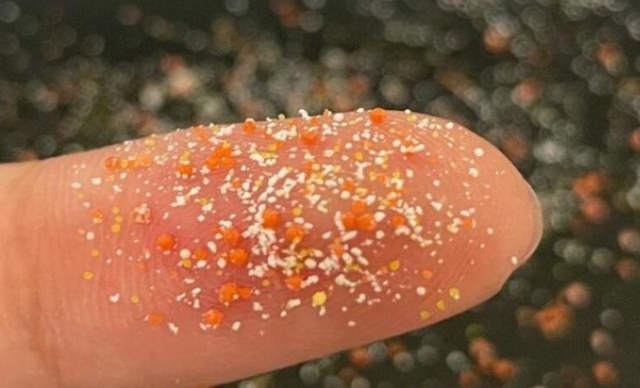 Microplastics: We can just barely see these tiny polluters. Nano-
plastics are a thousand times smaller. Too small to see,
but possibly thousands of times more abundant…
Nanoplastics are a thousand times smaller than microplastics. And until now, they were more diffi–cult to detect than their larger cousins. Which was one reason there seemed to be a deficit in the ‘inventory’ of discarded plastic in the world. As in, it appeared, when you added up all the plastic we knew had been manufactured since plastics came into widespread use… There was a huge amount of ‘missing plastic. Call it ‘Dark Plastic’…
Too small to see
Well, the plastic is there. Scientists from the Royal Netherlands Institute for Sea Research (RNISR) they simply had no way of detecting them, previously. Now, using new molecular spectroscopy technology at the University of Utrecht, they’ve found the plastic and made accurate estimates of how much there is literally floating around out there.
Helge Niemann, researcher at NIOZ and professor of geochemistry at Utrecht University, spent a summer on the North Atlantic sampling water at 12 different locations in he North Atlantic. Then, using the new new processing techniques to separate the particles smaller than in micrometre fro the water the water.
‘A shocking amount’
What was left, when extrapolated to the whole North Atlantic ocean, was more than 27 million tons of nanoplastics. Material that had been effectively invisible before.
“A shocking amount,” Ten Hietbrink believes. “But with this we do have an important answer to the paradox of the missing plastic.” Until now, not all the plastic that was ever produced in the world could be recovered. So, it turns out that a large portion is now floating in the water as tiny particles.”
What’s really alarming is, the researchers say the non-plastics particles are also Floating in the air and coating everything via a process known as dry deposition. like like house dust on the mantel-piece, but many times finer.
Fundamental consequences
The consequences of all those nanoplastics in the water could be truly fundamental, Niemann em-phasizes. “It is already known that nanoplastics can penetrate deep into our bodies. They are even found in brain tissue. And The main vectors they’re using to invade us are the air we breath, the food we eat and the water we drink…
Now that we know they are so ubiquitous in the oceans, it’s also obvious that they penetrate the entire ecosystem; from bacteria and other microorganisms to fish and top predators like humans. How that pollution affects the ecosystem needs further investigation.”
It also means that there’s currently no way the nanoplastics can ever effectively be cleaned up.
Prevention the only ‘cure’
Niemann says that the only thing we can do to mitigate the further spread of, and pollution of the environment by of nanoplastics is to prevent the generation of more of them. And nobody on the RNISR team has any kind of answer to that question…
~ Maggie J.