
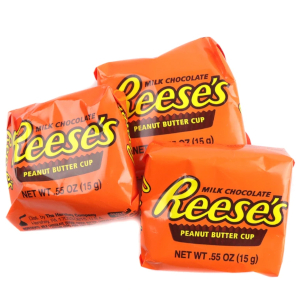
The old quasi-holiday, Hallowe’en, has waned in popularity over the first half of this decade. It stared with the complete shutdown of trick-or-treating during the COVID. And ‘civilians’ like you and me don’t realize what a blow that’s been to the candy sector!
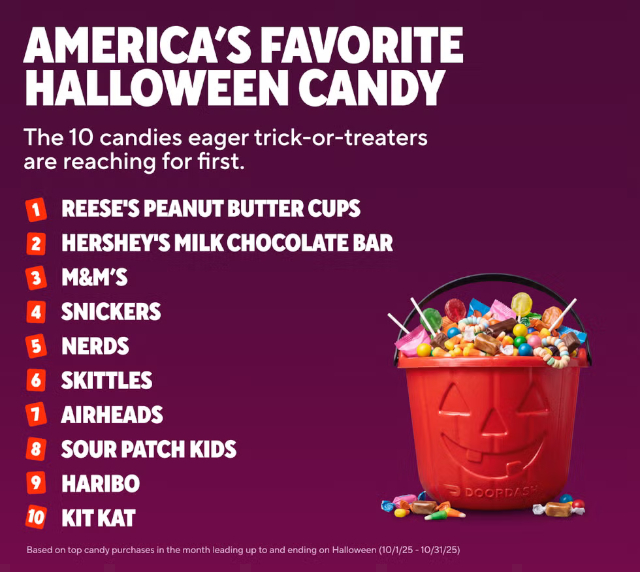
The above DoorDash digest of last year’s deliveries of Hallowe’en Candy tells a familiar tale. But it doesn’t reveal the damage the now-permanent shift away from traditional Hallowe’en activities has wrought upon the candy industry..
Once upon a bonbon…
I remember taking out a pillow case to collect Hallowe’en candy when my age was still measured in single digits. Everybody did. Because you got a lot of candy – and later, chips. And that was because everybody – literally every house except one or two (where ‘the weirdos’ lived) had their porch lights on, and a carved Jack O’ Lantern by the door.
The last year we handed out treats to the kids was a mere shadow of the event’s former glory. We regularly has north of 125 kids at the door on Hallowe’en the first year I lived at my present address. Fifteen years later, post-COVID, the tally had shrunk to about 35. And the next year, even my close neighbours with T-or-T aged kids said they got pitifully few. They, tellingly, had decided their kids weren’t going out anymore. Too much trouble to set it up. Too much worry…
Another telling detail: We were handing out single-serving bags of chips the last few years we ‘shelled out’, not candy. They were easier to handle and – perhaps more importantly – cheaper.
The breakdown…
Hershey’s and it’s wholly-owned sister brand, Reese’s, dominated the popularity ratings for the ump-teenth year in a row. Chocolate and peanut butter still rule!
M&Ms and Snickers came 3rd and 4th, in that order, consolidating the supremacy of chocolate as THE gift candy.
The came the pivot point… Nerds came 5th, and Skittles landed in 6th place, marking a change in course from chocolate to other tastes.
After that, it was the sweet/sour and chewy bites that took the spotlight: Airheads, Sour Patch Kids and Haribo Gummies.
One saving grace for the candy sector: the timeless favourite, Kit Kat, remained in the Top Ten, though trailing in last place.
The global significance of candy
“Candy is a universal delight,” the Hospital Equipment Manufacturing Company’s HEMC Journal tells us. “Its appeal spans cultures and generations. According to research by Statista, the global candy market was valued at approximately $200 billion in 2021. This figure reflects a growing love for sweets worldwide. Candy is not just a treat; it’s an emotional experience. It evokes joy and nostalgia.”
The Journal goes on to explain: “Many people associate candy with childhood memories. However, the consumption patterns reveal complexities. While candy brings happiness, it’s important to con-sider health impacts. Excess sugar consumption can lead to health issues. In 2020, the World Health Organization reported that high sugar intake is linked to obesity. This raises questions about balance in candy consumption.”
Winds of change…
… Are blowing in gusts through the candy industry. Some gale force developments have forced candy makers to explore other sectors such as manufactured beverages, where the market is overwhelm-ingly ‘recreational’, and the demand is expanding.
One reason is, in recent years, the cost of cocoa and sugar – the two main ingredients in all forms of candy – have skyrocketed. And thanks to climate change, the painfully high price of oil and other combining factors, the cost to make candy has gotten completely out of control. Manufacturers have pulled every trick out of their collective pocket to try and keep the label price of their wares within a range folks will accept. But the breaking point has just about been reached there, too.
What does that mean for candy?
According to the US Bureau of L (BLS), the Consumer Price Index (CPI) for candy rose 32 per cent between 2019 and late 2024. Holiday and Halloween candy prices ballooned even faster – by 2025, a standard 100-piece bag of candy cost nearly 78 percent more than it did in 2020 ($16.39 vs. $9.19).
Meanwhile… According to data from Circana (Chicago) for the 52-week period ending May 18, 2025, the chips category, “brought in a total of $11.6 billion for the year 2025. That figure represents just a tiny loss of 0.1 percent compared to the previous year. Unit sales are also down just 0.1 percent for the period (with 3.7 billion units sold),” Snack Food & Wholesale Bakery magazine reported.
At the same time, folks are turning massively to healthier snacks – the transitional product of which seems to be Apple Chips. They’re ‘chippy’, for sure. But they’re also sweet…
My take
The available figures seem to suggest that folks are not cutting their spending on Hallowe’en candy, but they’re buying less – fewer pieces – than they used to.
Thus are candy companies still cashing in on the emotionally-charged ‘candy holidays’, including Valentine’s Day and Easter, when the gesture they’re making is more important than the price they’re paying. There’s also the fact that each of those ‘celebrations’ comes only once a year. Candy is not a huge extra expense every month… Human beings are masters at rationalizing splurges.
But the younger generations are into healthy eating, and they’re buying healthier treats. Economists say it’s only a matter of time before candy sales truly tank, and the whole face of casual eating gets a makeover after which it may well be unrecognizable.
Nevertheless, the landscape of snacking territory is changing markedly, and quickly. Snack makers probing each others’ niches and buying up complementary brands in other sectors. It’s looking as though, soon, most snack makers will be playing in all the major product categories: sugary and healthy beverages, sweets, salty snacks, and ‘healthy snacks’ in general…
~ Maggie J.