They let an AI program loose to create menu item images for Restaurants. And the images it delivered were… Let’s say, totally unusable. Now, Stanford University has set its AI wizard the task of coming up with the the World’s Best Burger…

… And the results were… Lets say, more palatable. A select few more so than a Big Mac, in fact!
A little history…
The menu images project faltered not on its premise, or the material the system was given to learn from. It failed miserably – sometimes amusingly, others horrifically – in its inability to understand metaphors, or the concept of symbolism.
We mere humans all know how flowery and referential the names of dishes on menus can be. But an AI system, with its relatively limited ability to interpret what it sees, not to mention its unchained freedom to make whatever kind of pictures it deems appropriate, was bound to make a monumental mess of the menu images task.
For example… Told to create a picture of the ultimate Big Mac, it might have gone looking for a source image of the biggest guy named Mac it could find on the internet. And then put him between two buns, dressed up like McDonald’s famous recipe. complete with the Special Sauce.
The Stanford Trials…
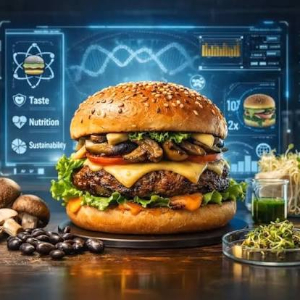
Stanford researchers gave their algorithm, BurgerAI, freedom of the Web to gather information about burgers digest it, and come up with ‘better’ burger recipes’. The team asked the system to create re-cipes under three categories: optimizing for taste, sustainability, and nutrition.
After 10 trials, “Burger AI generated an average of 7.3 million plausible burger recipes [per trial] before producing one that matched a reference version of the Big Mac in both its ingredients and their proportions,” Food & Wine reports.
Overall, “The researchers asked BurgerAI to generate new burger recipes — 1 million of them — optimized for taste, sustainability, and nutrition. They selected five of the most representative recipes among the three categories, reasoning that the combinations the model generated most often would also be the most appealing to eat.”
The real-world test…
The results Burger AL pumped out came in the firm of ingredient lists only. So the Stanford team chose the top 5 candidates in each of the three categories, according to their own tastes, and asked a team of professional chefs to c0ok-up actual examples.
A panel of over 100 volunteer taste testers was assembled, and they all tried each of the total 15 candidates for best burger, along with a genuine Big Mac, from McDonald’s.
The result…
… Surprised everyone involved. Two of the AI burgers beat the Big Mac. One was rated as meatier, juicier, and richer than the fast-food classic, while the other stood out for its meatier flavor and smoky notes.
A third burger tied the Big Mac for diner appeal. “[It] blended mushrooms with beef, [and] struck more of a middle ground,” Food & Wine says. “It delivered a substantially lower environmental im-pact than the Big Mac while earning comparable ratings for flavor and overall liking, suggesting that, in this case, the model was able to improve sustainability without sacrificing consumer appeal.”
My take
One of the biggest advantages BurgerAI had over its menu-item picture generator was that it didn’t have to create images of the burgers its recipes would produce.
One thing I’m wondering… What’s going to happen to the ‘winning’ recipes which were judged better than the Big Mac? I’ll bet all the burger giants – including McDonald’s – would give millions to get their hands on them!
~ Maggie J.