

Last Friday, we asked, “What’s Kellogg’s up to with their new Nutrition Benefits label?” The answer was, “Pumping up the smoke and mirrors.” Today, we dissect Kellogg’s new SPOONS acronym, and the ‘framework’ behind it…
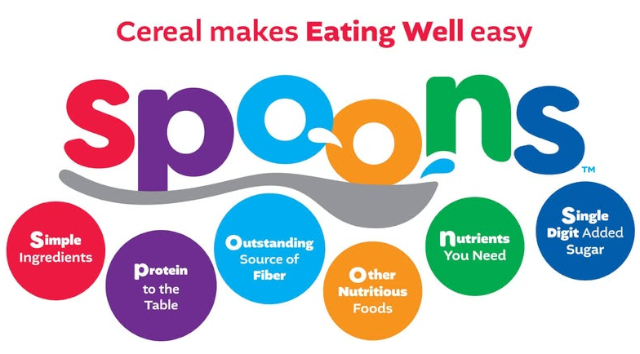
Kellogg’s wants you to think they’re sugar-bomb, kid-targeted breakfast cereals are now healthier than they used to be. Because Kellogg’s has added Protein and fibre and is spotlighting questionably healthy stuff that was already in there…
The SPOONS ‘framework’
-
- S – Simple ingredients: Highlights minimal, recognizable components.
- P – Protein: Promotes protein content, particularly when combined with milk.
- O – Outstanding fibre: Highlights cereals high in dietary fibre.
- O – Other nutritious foods: Notes additions like whole grains, fruit, and dairy.
- N – Nutrients you need: Focuses on essential vitamins and minerals like iron, folate, and calcium.
- S – Single-digit sugars: Identifies options with 10 grams or less of added sugar per serving.
A companion effort
Kellogg’s also publishes an online guide to interpreting the official, government-mandated nutrition and ingredients information labels on all its products. Kellogg’s doesn’t seem to be straying too far from the True Way in its sparse descriptions of the elements of those labels. But it doesn’t go out of its way to point out what the multi-syllabic, tech-named ingredients in their products are, and why they’re there. If you knew, you might not buy them.
Nevertheless…
Kellogg’s is pressing ahead with its SPOON initiative as though it’s a revolutionary advance in con-sumer communications and corporate responsibility.
But if you seek out the industry publications, they focus on Kellogg’s true goals…
‘The Food Institute’ (TFI) sounds like a non-partisan, non-profit organization with the aim of reporting objectively on the food industry. It’s banner tag reads: ‘Your Single Source for Food Industry News, Data and Trends Since 1928″. Fair enough. But who’s source? The industry, that’s who.
An industry view…
I offer a few choice snippets and quotes from TFI’s story on Kellogg’s SPOON program:
“Stephen Ellsworth, a retail expert who once helped co-found functional beverage brand Poppi, told TFI. “Consumers are tired of being sold a bill of goods,” Ellsworth added. “They’re demanding great-tasting products with ingredients they can feel good about, and that bar is only getting higher.”
The key phrase there is that consumers need to ‘feel good about’ the products. And Ellsworth is correct in saying the bar on that factor is getting higher. Because people are getting smarter, and younger folks, particularly, are asking more questions about the food they choose.
Ellsworth adds: “This initiative can help re-educate shoppers, but at the end of the day, the product has to live up to the marketing — full stop.”This initiative can help re-educate shoppers, but at the end of the day, the product has to live up to the marketing — full stop.”
Desperate times…
There’s an old saying: ‘Desperate times call for desperate measures’. Which begs the question: “Why is Kellogg’s so Hell-bent on charming consumers?”
According to TFI, “SPOONS is part of WK Kellogg’s overall strategy to inspire growth within the $10 billion U.S. cereal category. The company said, in its latest press release, that cereal remains one of the most popular household staples, with 50 million boxes purchased each week.”
But TFI goes on to note that consumers are massively abandoning traditional breakfast foods, not-ably cereal, in favour of other approaches, not the least of which are Fast Food breakfast offerings. The cereals market has suffered a palpable hit over the past few post-COVID years. TFI even uses the term ‘eroding shelf space’ to describe the phenomenon.
An independent view…
“Consumers aren’t switching brands, they’re ditching cereal breakfasts altogether for higher-protein, lower-carb alternatives,” observes Bradly Guldemond, the owner of CPG Guy, a consulting service that advises packaged foods makers.
“Kellogg’s new SPOONS on-pack guide is another attempt to reposition classic cereals around fibre, protein, and single-digit sugars, but I see it as mostly an attempt to stop shelf space erosion,” Gulde-mond explains. “The highlighted fibre is highly processed and not what diets lack. The sugars are still a lot despite being single-digit grams, and much of the protein content relies on the added milk.”
And let’s not forget…
While hyping the fibre and protein to feed the current popular mania for more of those nutritional elements, the SPOON ‘framework’ still has no provision for giving the bad aspects of their products equal billing, and at least having a chance at capturing a fair share of shopper awareness. They don’t have to, so they don’t do it. The reasons are obvious…
My take
The most interesting line in the TFI article was the one in which even the story’s authors admitted, “That said, some industry insiders are skeptical that Kellogg’s latest initiative will make a significant impact,” on the decline of the cereal market.Bakeryandsnacks.com calls SPOONS a ‘make or break cereal play’.
I, for one, can agree with that…
Maggie J.