
Empty, discarded plastic water bottles are the most invasive ‘trash’ pollutant known to humanity. Billions – perhaps trillions – are floating in our oceans. But science may have found a new way to recycle them!
It’s actually more than recycling. The new discovery puts plastic water bottles in the upcyclable cate-gory. And that could be fantastic news for both the pollution picture and the global food supply…
Hard to digest?
Some folks may find the new plan hard to digest. Because it involves turning food grade plastic waste into edible protein. Up to now, the process has resisted attempts to make the new food palatable. But recent developments could signal the start of a new era, where converting plastic to food is a commercial and social reality.
The process…
The process, which researchers have been working to refine for several years now, is really a very simple one. It first breaks down PET plastic and plant waste into water-soluble molecules. Then, yeast converts them into protein.
The nutritive value of the ‘digested’ substance has been proven for some time. But making it useful in conventional food manufacturing processes has been problematic. Perhaps more importantly, the stuff has defied attempts to make it look and taste good.
In their most recent experiments, researchers have been able to use yeast to produce vanilla flavour-ing. And they’ve tinkered with and beta-carotene, a natural substance found in orange, yellow and red veggies, to give PET protein products a more-appealing golden hue.
A glitzy premiere…
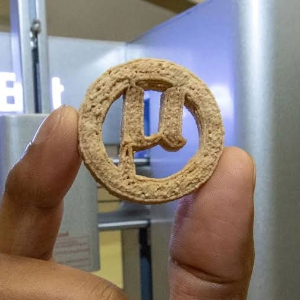
The latest version of PET protein was débuted recently at the American Chemical Society (ACS) Fall 2026 Conference in Chicago. The development team, from the Southern Illinois University, actually distributed samples of their ‘product’ – in the form of cookies they’ve branded ‘µBites’ (pronounced: ‘microbites’). (See photo, top of page.)
In an overview of their presentation, the team predicted its work could both feed millions of hungry folks around the world while taming the plastic water bottle pollution demon:
“With billions of people experiencing hunger in 2025 and unable to afford a healthy diet, food in-security remains a critical global challenge. ‘µBites’, originally developed for the NASA Deep Space Food Challenge, represents a novel way of producing nutritious food by converting plastic and plant waste into edible, protein-rich supplements. Beyond space travel, µBites could offer a promising solution to address both food shortage and plastic pollution simultaneously.”
Miles to go…
That may be an attainable goal. But it’s still way off in the future. The next challenge for the project to overcome will be getting the food industry to adopt the technology, and developing viable com-mercial products based on PET protein.
And one major drawback in getting the upcycling show on the road will be the high cost of fuel to transport used bottles to processing plants where they can be converted to protein. One suggestion is to compress the bulky bottles close to where they’re collected, either by chopping them into small chips or ‘withering’ them with heat into clumps of solid plastic. This would allow the transportation of much more plastic waste per truckload.
My take
So… Say, ten years from now, the real crunch will hit the world’s food supply, from climate change and all the other factors pushing in from all sides. But it seems mountains of ‘new food’, made from recycled, converted water bottle plastic might actually be ready for prime time.
I’m going out on a shaky, bendy limb here, but I think this development of PET protein that’s actually palatable to humans could be the ultimate opportunity for the Ultra-Processed Food (UPF) makers to redeem themselves for their nutritional crimes… By spearheading the development of new PET pro-tein products using their wealth of knowledge and experience in flavouring, texturing and colouring all sorts of ingredients…
~ Maggie J.