
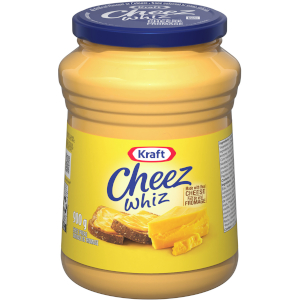
When I think of ultra-processed food, one of the first products that comes to mind is…. Cheez Whiz! The humble, ultra-meltable product has travelled across the Atlantic and back about three times. And I’m proud to say, Cheez Whiz was perfected by a Canadian!
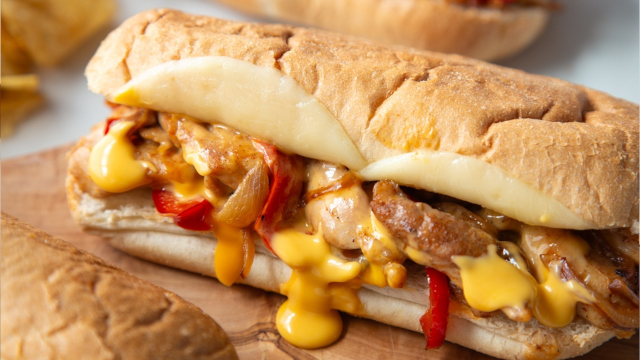 Authenic Copy Cat Philly Cheese Steak: Made with ‘genuine’ Kraft Cheez Whiz…
If Cheez Whiz reminds you of American (Processed) Cheese, that’s because it was perfected by the same Canadian culinary innovator. And shares a lot of the same technology and ingredients. In fact, just about the only difference between the two is the texture. Kraft’s legendary singles slices are, first and foremost, engineered to melt easily and consistently. And Cheez Whiz is always ‘perfect spread-ing consistency’, right from the jar.
Perfect for a Netflix Limited Series…
The Cheez Whiz Saga began in Switzerland in 1911, when a pair of European inventors, Walter Gerber and Fritz Stettler, developed the original Processed Cheese method. But it was Canadian J.L. Kraft who tweaked the formula to what we call Processed Cheese today, patenting his combination of ingredients and method in 1916. The impetous for his effort was a US government call for food scientists to develop a spread-able cheese that could be canned, and would last indefinitely in soldiers’ field rations during the First World War.
Kraft was rewarded by the US Army for his efforts with monumental orders – totalling more than 6 million pounds / 2.7 million kg – by the the War’s end in 1918. And made a killing.
Processed Cheese 2.0
What you might call ‘Season 2’ of the Cheez Whiz story focuses on the post Second World War era, when millions of American and allied servicemen brought back with them from overseas an insa- tiable taste for Processed Cheese. And Kraft cashed-in a second time, on the ‘home’ market.
Progressive Grocer magazine reported that the advent of pre-sliced Kraft Singles increased North American Processed Cheese sales by as much as 150 percent by 1950. And J.L. made another killing.
Parallel developments
In parallel with that line of evolution, Kraft – always with an eye to a new market or application – noted that fans of the British favourite Welsh Rarebit (sometimes, ‘Rabbit’) were begging for an easier way to prepare smooth, creamy melted cheese. Rarebit is simply a good, stout, ideally artisan, pump-ernickel or regular rye toast topped with a special Cheddar cheese sauce. Distinguished from all other variants by the addition of beer.
Another tweak or two and – Presto! – J.L. had ‘invented’ Cheez Whiz. Folks (outside Switzerland, any-way) quickly got used to orange-coloured Fondue, which boomed through the 1950s and on into the mid 60s. And J.L. made yet another killing.
One notable side effect of the Cheez Whiz sauce boom was the rise to ‘legend’ status of the iconic Philly Cheese Steak, a Hoagy-like sandwich that could finally be made at home as effortlessly and succulently as it still is at the original South Philly street food stand.
My take
Over the decades, unique, quirky Cheez Whiz has cemented its status as one the all-time Top 10 foods you either love to hate or hate to love. More recently, it’s been adopted by lovers and haters alike as the ‘poster child’ of the ultra-processed food boom.
Meanwhile, third-party food scene observers are already on the edges of their seats, wondering what ‘Phase 3’ of the Cheez Whiz Saga will look like…
~ Maggie J.