
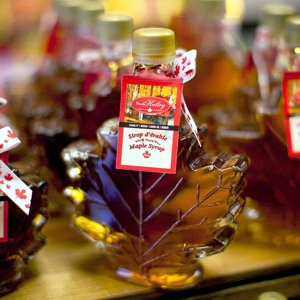
I’ve been seeing a number of posts lately about how to ‘spot’ fake or doctored Maple Syrup. They were triggered by reports about a Québec producer who multi-failed, deceiving wholesale buyers and consumers. How can you tell you’re getting real maple syrup?
 What’s on YOUR pancakes?
Maple syrup pros can tell the difference just by looking, smelling and tasting. You should be able to, as well. But it might take some practice, comparing the good, the bad and the ugly side by side…
Kinds of syrup ‘faking’
Maple syrup has entered the ranks of ‘suspect foods’, with olive oil, chocolate and other commodities which are so expensive to begin with that some unscrupulous types in the supply chain are tempted to cheat, and pump up their profits.
There are several ways crooked producers, packagers and wholesalers can ‘fake’ maple syrup:
- Simply water it down (dilution).
- Water it and add (cheaper) sugar to bolster the sweetness.
- Water it and add colouring to disguise the dilution.
- Add fake labels to bump up the perceived quality, grade or place of origin.
Dilution
Watering down syrup affects the viscosity (thickness, or ‘syrupy-ness’) of the product – one reason fakers often add plain cane sugar syrup to cover their crime. But watering the syrup also affects the flavour – another reason fakers add back plain sugar.
Fakers may add caramel colouring to make the diluted syrup look darker. This can also be done to ‘pure’ undiluted lower grades (i.e.- ‘Amber’ or ‘Light’) grades of syrup to help it pass as more con-centrated and, therefore, more expensive product.
Label faking
This approach is, perhaps, the most common type of fakery. It can take place at the packaging or wholesale stage in the ‘pipeline’.
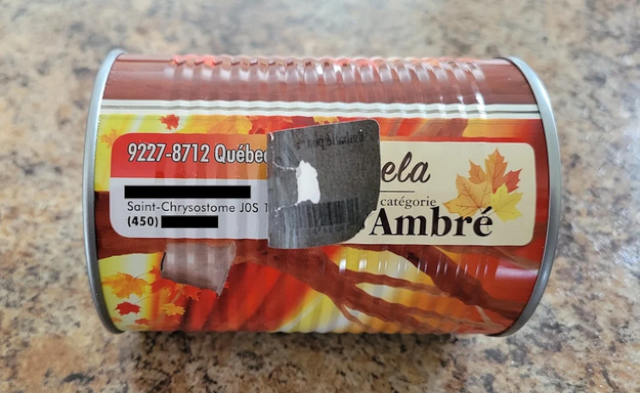
A CBC follow-up probe discovered adhesive labels concealing the real origin
of fake syrup from the producer targeted in its original sting…
Label faking can be as simple as labelling New Brunswick or Ontario syrup as ‘Product of Québec’. That’s what the target of the CBC investigation is accused of doing, to increase the value of product he imported from neighbouring provinces.
Faking has commonly consisted of simply labelling a lower grade of syrup as a higher grade and, therefore, worthy of a higher price. It can be as simple as displaying the word ‘PURE’ on the label when the contents are adulterated.
How do you know?
Experts told CBC News there are several ways you can tell the real deal from fake maple syrup. And they involve all your gustatory senses…
If syrup looks lighter than expected, that could be a sign it’s watered down. If it tastes sweet enough, but the maple flavour and aroma notes you expect are not as pronounced as you expected, that would constitute another cue.
But there is one sure way to know if your syrup is genuine. The Maple Lady at The Maple Farmer (on Facebook) reminds us that all we need to do is check the ingredients list on the back of the container… If the list contains anything other than ‘Maple Syrup’ it’s not the real, pure thing. It takes two seconds. Bam! But her method only works if the producers are being honest. And most of those ‘faking it’ probably aren’t.
My take
There’s one other way to tell – or at last suspect – that a container of maple syrup is real or fake. And it’s the container, itself. Most genuine maple syrup comes in either cans or clear glass bottles. The producer who was targeted by the CBC as a scammer packed his in cans. Which could well have been a calculated move to keep consumers from comparing the colour of the product with other brands in the store. (Or am I just outing myself as a (mild case) conspiracy theorist, here?)
The bottom line…
… IS the bottom line. The guy who was fingered in the BC sting admitted to undercover reporters that he was selling his product for $5 per can to major Ontario supermarket chains. Consumers who con-tacted the CBC about their experiences said they paid anywhere from $7 to $11 per can for what they suspected was bogus syrup. We’re talking big bucks, here. Potentially, monumental fraud.
And let’s not forget the image factor. Québec produces 80 percent of the world’s Maple Syrup. And the product’s purity and quality are points of pride both for the province and all of Canada.
“It truly outrages me. Québec consumers don’t deserve this,” Quebec Agriculture Minister Donald Martel told Radio-Canada. “Maple products are kind of part of our heritage. Anyone who wants to mess with that, well, I don’t have much respect for them.”
An understatement, if ever I heard one!
~ Maggie J.