
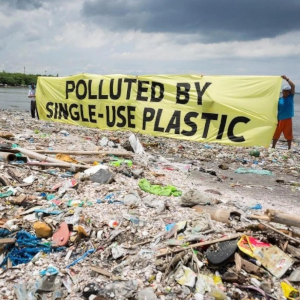
There’s no more-pressing problem – in the eyes of medical researchers – than the accumulation of microplastics in our bodies. They’re tiny bits of plastic waste carried into our food by the water they absorb. But there may now be a ‘treatment’ for the affliction…
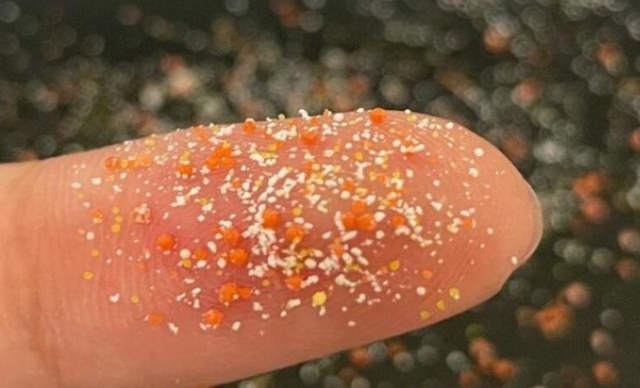
The tossing and churning of the eternal ocean waves can quickly grind down waste plastic into tiny particles like the ones pictured above. And even tinier ones, measured in micrometres and nano-metres, that we can’t even see with unaided eyes…
Less is more – dangerous
Scientists say the smaller the microplastics, the greater the danger they’ll get into our very cells – affecting all our organs and degrading our health. If you thought that was bad news, there’s worse… Until now, there hasn’t been any way of ridding our bodies of this minuscule invaders.
A breakthrough?
Researchers at the World Institute of Kimchi recently published results of a new study which showed that a bacterium found naturally in Korea’s national dish – Kimchi – seek out and bind to micro-plastics before being eliminated in feces.
In lab studies, under perfect conditions, it cleaned up 87 percent of the microplastics provided in the experiment. Even in a particularly harsh gut environment, the bacterium eliminated almost 60 per-cent of the microplastics it encountered.
What is it?
Leuconostoc mesenteroides CBA3656, a lactic acid bacterium found in fermented cabbage. And there’s no more-concentrated form of fermented cabbage than Kimchi. In Korea, that is. The researchers haven’t yet tested other such foods – notably Sauerkraut – which could show promise.
My take
If this bacterium can be cultured and made into a pill or capsule, it could be the answer to the micro-plastics scourge. That kind of treatment may not be a cure, but it certainly does address the danger effectively. Even if someone comes up with an equally effective way to clean up the oceans, where microplastics ‘breed’, there are still enough in circulation to pose a mass health threat until well into the next century…
~ Maggie J.