
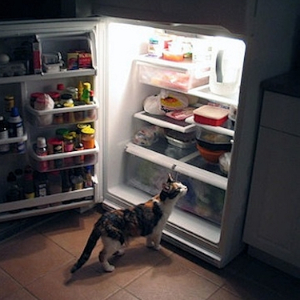
Reading through the headlines on a trusted online food newswire service, my eye stopped abruptly at one dealing with recommended refrigerator temperatures. I had thought most folks were well clued-in about where to set their fridges’ thermostats. But apparently not!
 Meet FAT TOM…
One of the 6 foundational tenets of food storage safety is Temperature. It is enshrined in one of the professional cook’s oldest and most cherished acronyms: FAT TOM:
Food type
Acid content
Temperature
Time out of refrigeration
Oxygen exposure
Moisture content
Together, those conditions determine whether a particular food item is safe to consume.
TOM has rules…
Food professionals all know that there is a danger zone between 4 C/ 40 F and 40 C / 145 F. Below that you are ‘okay’ – refrigerated or frozen. Bacteria can’t grow or reproduce. Above that, you’re liter-ally cooking. At least ‘warming’ on the buffet. It’s one of the main factors health inspectors check at restaurants.
Among the basic rules of food storage is that your fridge always maintain a temperature no higher than 4 C / 40 F. Seems easy enough. Just set the Fridge compartment thermostat to 4 C / 40 F and you’re golden. Apparently, it isn’t that easy, though…
There are many reasons that just setting the fridge and forgetting is not really good enough to ensure safe temperature keeping.
There’s a door…
… And it keeps getting opened and closed – sometimes staying open for precious seconds or even minutes, dumping cold air out onto the kitchen floor.
Cold air is heavier than warm air. And the cold air in your fridge will literally just fall out when you open the door, letting warm air in at the top of the insulated box. That causes a temperature differ-ential that almost guarantees the shelves at the top of the fridge will always be a little – or a lot – warmer than the ones at the bottom, and the crisper drawers.
The hierarchy
Hence the allied rule that foods most sensitive to temperature (eg.- fish and poultry) be placed at the bottom while those not to critical (butter and eggs) be placed at the top.
In fact there’s a formal hierarchy for arranging foods according to their temperature sensitivity. (See infographic, above, for an illustrated rundown…)
Maintain a balance
At the same time, though, it’s important to ensure that you don’t set your fridge too low. That could allow temperatures – especially those in the bottom of the insulated box – to fall below freezing. And there are many foods that we definitely don’t want to freeze, Such as most fresh fruits and produce, most dairy items, and most packaged products whose labels instruct us to ‘refrigerate after opening’. In any case, most foods that freeze by accident in the fridge compartment can automatically be con-sidered ruined.
No warm or hot foods
Never put hot foods or even warm (above room temperature) items in the fridge. Their warmth may raise the overall temperature in the fridge compartment – perhaps above the ‘safe ceiling’ of 4 C / 40 F.
A comprehensive reference
Good Housekeeping magazine provides us with a convenient, comprehensive reference to proper fridge management. Not surprisingly, many of its rules and recommendations are temperature-related.
I keep this page bookmarked in my web browser…
My take
Food safety is one of the most important issues in the foodservice universe -and your kitchen. That’s evidenced by the hundreds of food and related recalls open at any given time. Just click over to the appropriate link for your region in the list of recall information sites at the bottom of the sidebar (extreme right) on this page.
Be sure to check your fridge occasionally to endure that it’s sitting within the small okay zone be-tween ‘freezing’ and the ‘safe ceiling’. And tweak the thermostat as needed. You may have to reset in the winter and summer as the seasons change and the ambient temperature – outdoors and in your kitchen – eases up and down.
As much as I try to remind faithful readers of the rules so we’ll all be safer… I fear I’ll be back here in another few of years going over them again for the next generation of up-and-coming home cooks.
But it’s always better to be safe than sorry…
~ Maggie J.