
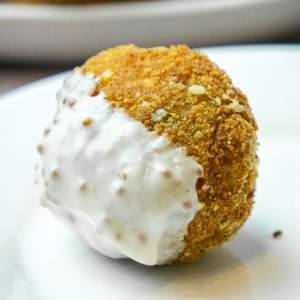
Say ‘Haggis’ to anyone but a born-and-bred Scottsman (or woman), and you’ll probably get one of the most quizzical, abhorrent, nauseated reactions you’ve ever seen. But now there’s something completely different: Newstalgized Haggis Bon-Bons!
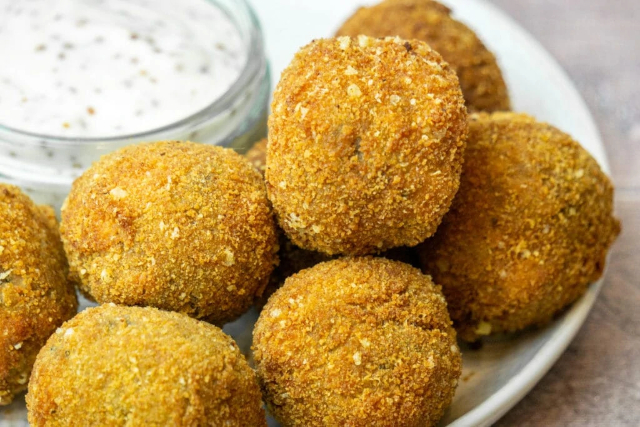
Haggis has become legendary – not for anything good, but for the gustatory evil it represents. Wikipedia describes it as, “a savoury pudding containing sheep’s pluck (heart, liver, and lungs), minced with chopped onion, oatmeal, suet, seasonings, and salt, mixed with stock. […] It’s tradit-ionally encased in the animal’s stomach though now an artificial casing is often used instead.”
Well… When you put it like that…
However, the 2001 English edition of the Larousse Gastronomique: is more diplomatic, focusing on the dish’s saving graces: “Although its description is not immediately appealing, haggis has an ex-cellent nutty texture and delicious savoury flavour.”
A version for everyone
Now, there’s a version of Haggis that answers the unspoken questions about all those entrails and organ meats, but maintains the texture, flavour and overall ‘character of Haggis in a much more acceptable format.
We’re going to mix up a Haggis filling using only lamb (or mutton) meat, rather than the ‘pluck’. And we’re going to bypass the sheep’s stomach altogether, making egg-sized balls and running them through a conventional 3-stage breading line…
Streamline, update, upgrade…
Alton Brown (a good Scotts name!) – the face of those Food Network ‘the-science-behind-cooking’ shows of yesteryear – has a traditional Haggis recipe which we can easily streamline, update, up-grade and altogether newstalgize.
The flavour of Haggis depends on a convival meeting of the ultra-umami, earthy, gamey essence of lamb and a collection of traditional herbs and spices, including: coriander, cumin, nutmeg, rosemary and thyme.
Don’t substitute other hard fats for the suet. Suet is one of the key elements that makes authentic Haggis what it is.
Brown also stresses that you must use only steel-cut oats for this dish. “Steel-cut oats deliver the right chewy texture and nutty flavor. Do not use rolled or instant oats.” For best flavour, Brown sug-gests you toast the oats, “in a dry skillet over medium heat until aromatic and slightly golden.”
Pre-cook the lamb, and remove it from any bones it came attached to, and chop or shred it before mixing up the Haggis filling. You can use any cooking method you like, but be sure not to lose too much of the meat’s natural juice. It’s pure flavour ‘gold’! I’d just simmer the meat, in a plastic cooking bag to retain the juices, and not let them diffuse into the cooking water.
Switch channels…
Now, switch channels, as it were, over to the Bon-Bons recipe, from Phil & Sonja, the highland cuisine experts at scottishscran.com.
First, let the Haggis mixture cool to room temperature or lower (but not refrigerated). Then beat an egg and mix it into the meat ‘pudding’ as though you were massaging a meatloaf. You can now pro-ceed with ‘final assembly’…
To make the bon-bons, form the haggis filling into balls about 1 in / 2.5 cm in diameter. From there, you can adjust them into egg-shaped ovals, for visual effect – if you like.
Then, dip the balls into seasoned flour, beaten eggs and, finally, bread crumbs to form a nice coating. It’s always a good idea to let crumb-coated objects such as our bon-bons rest undisturbed in the fridge for half an hour before cooking, to ensure that the coating sets and sticks to what it’s coating.
Shallow-fry the bon-bons in 1/2 in / 1.5 cm of neutral flavoured oil such as Canola, for 3-5 minutes. Turn often, ensuring all sides are equally browned.
Serve hot…
… With tradional Scottish root veggies (boiled potatoes, carrots and turnips) on the side.
If you think that’s a pretty bland veggie side, remember how flavourful and aromatic the Bon-Bons are! The main and side make great completmentary ‘foils’ for one another!
My take
These ‘bon-bons’ can be served hot or cold, with any number of different sides. You can also look upon them as little personal meatloves, and slice them into sandwiches or buns.
Have a little fun with your dining audience. Let them think the crusted brown objects on their plates are Scotch Eggs. What a pleasant surprise they’ll get when they bite into them!
~ Maggie J.