
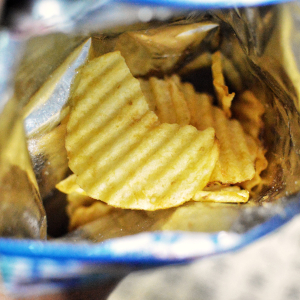
The air in your chip bag isn’t air. It’s something more sophisticated, and it’s there to make your fave snacks more enjoyable. Here’s how chip makers learned about the physics of the shipping process and the chemistry of freshness…
Not a secret
And it’s not an industry secret. The extra space in the chip bag has two functions. One is to pre-serve the product’s physical integrity during shipping and handling. The other is to preserve its freshness and texture.
If not air, then WHAT?
Simple Nitrogen gas. Chemically speaking, 78 percent of Earth’s breathable air is made up of nitrogen. Just 21 percent is oxygen. And the remaining one percent is made up of carbon dioxide, various inert gasses and pollutants.
Nitrogen has many useful properties. Unlike hydrogen, its close neighbour on the Periodic Table of the Elements, it’s not combustible. But it isn’t as light as another neighbour, Helium. Helium, too, is non-combustible, and therefore preferred for filling birthday party balloons and lighter-than-air flying machines.
But Nitrogen has other charms, particularly for food packagers.
But WHY?
Nitrogen and oxygen don’t mix. In fact, nitrogen can push much of the oxygen out of a storage con-tainer or retail package, extending the contents’ shelf like by eliminating the ‘oxidation spoilage’ factor.
It’s also widely used in packaging perishables such as meat, seafood and fresh produce.
So puffing your chip bag with nitrogen just before sealing it is, in fact, enhancing your eventual en-joyment of the product, protecting the flavour and texture of the product.
But nitrogen may not be the end of the story! Kevin Spencer of Oak Brook, Ill., is a former scientific consultant for France’s Air Liquide and grocer Safeway of Britain. He says the inert gas argon is widely used in the UK for food packaging and preservation, but not in North America. It has a significant ad-vantage in the it’s heavier than nitrogen and, therefore, can push more of the oxygen out a food con-tainer…
Hard knocks
The snack industry has always been concerned about product damage on the way from the bagging line to your mouth. And hydrogen puffing offers a big bonus, acting as a cushion of insulation that protects fragile products such as chips from the physical hazards of shipping.
To paraphrase Shakespeare in Hamlet’s most famous ‘To be or not to be?’ soliloquy…
“… to say we end
The heart-ache, and the thousand natural shocks
That Snacks are heir to? ‘Tis a consummation
Devoutly to be wished.”
Not perfect…
… But it’s the best solution the industry has yet come up with to maintain your chips’ structural in-tegrity. The truth is, your delicate deep-fried, crispy snacks suffer a little physical degradation every time they’re jostled. The chips crash against each other, breaking and, eventually, creating the inevit-able crumbs in the bottom of the bag. Like sea shells being eroded to sand by the relentless action of the tides…
Which makes me think there may be no perfect solution to this old-as-packaged-snacks problem.
My take
Bravo to the person (whose name is apparently lost to history) who first thought to add nitrogen to salty snacks packages!
On the other hand.. If the UPF makers invested as much time, thought and money on making their products healthier – the whole world would be far, far better off!
~ Maggie J.