

Cottage Pie is just that. A casserole that originated in farm workers’ cottages, using what they had on hand. It’s a close English cousin to Scottish Shepherd’s Pie. And it’s due a revival today, when more and more folks are struggling to feed their families…
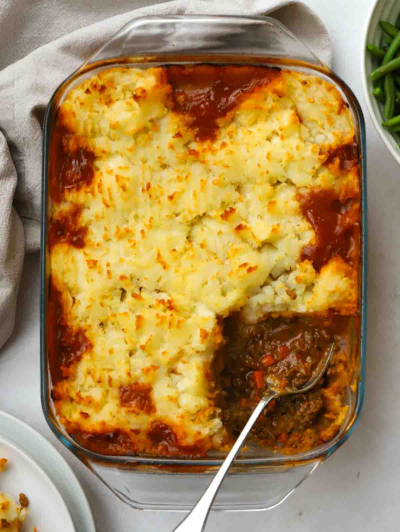
Cottage Pie appeared frequently on the supper menu when I was little. My Mom and her Mom actually called it Shep-herd’s Pie – an artifact of their Scottish heritage. To them, the English equiv-alent, identical in all but one respect, was decidedly inferior. It relied on ground beef, rather than the lamb traditionally used in the Scottish original.
Ironically, perhaps, Grandma had to settle for ground beef when she and Grandpoppy brought their family to Canada. Lamb was unavailable, Mom recalled, unless you raised it yourself. And Poppy, a classic thrifty Scotsman, wasn’t prepared to make that commit-ment just so he could have ‘real’ Shep-herd’s Pie. As a result, Mom grew up making it with ground beef. But she called it Shepherd’s Pie until the day she passed…
Simple ingredients
The principle components are ground beef, onions, green peas and maybe some turnip or carrot cubes. Some folks ad corn kernels, too, but that’s a strict no-no, especially if you’ve been brought up in the ‘Shepherd’s Pie’ tradition!
And that ‘stew’ is topped off with creamy mashed potatoes, dressed with butter so they’ll brown in the oven.
Like most dishes that owe their creation to hard times or humble circumstances, Cottage Pie com-bines a few cheap, simple but abundant ingredients into a rib-sticking, filler-upper that checks all the ‘balanced diet’ boxes – at least on paper. You’ve got meat, veg and starch. What more could you ask for? Except maybe a fresh tossed salad on the side to complete the ideal ‘Canada’s Food Guide‘ dinner plate?
What you do…
While the potatoes simmer, scramble the beef in a high-sided frying pan. Pour off as much excess fat as you can. I actually use a fine-mesh strainer for this job. But it’s important to leave enough fat in the pan to make a Roux. That will be the basis of the ‘sauce’ for the ‘stew’.
Go ahead and add a corn-starch or flour slurry at this point, and adjust the volume of the sauce using beef stock, or something like apple juice or beer. In estimating the volume of sauce you’ll need, take into account the volume of the veggies to be added. You want to achieve a thick, rich sauce that enrobes all the other ingred-ients, but doesn’t run out onto the plate.
Authentic flavour
Now is a good time to add the traditional herbs that give Cottage Pie the character it’s famous for: Sage and Thyme.
This is also the best point to add salt and pepper to taste. The other ingredients will be add to the beef flavour-wise. You should only need to taste for seasonings at the end of the filling prep stage
Place the filling mixture in a deep casserole dish or dutch oven – depending on how high you plan to pile the topping.
Mash the spuds, mixing in a little butter and cream if you prefer. That will give you a more elegant finish on the top of the dish. Drizzle melted butter over the top of the potato layer before placing in a pre-heated oven at 350.
If the top of the casserole is still not golden brown by the time the filling is bubbling, turn the heat up to 400 for the last few minutes of cooking. And keep a weather eye on it.
My take
There are folks who insist that you have to add a dash of Worcestershire sauce to the filling of a Cottage Pie to make it truly authentic. I consider that a culinary sin, punishable by withholding Cottage Pie from the miscreant until they change their tune. And legions of Cottage Pie fans agree with me…
~ Maggie J.