
In the 1950s and 60s, Moms across the Western World gave pork a lot more respect than cooks do today. We had a pork roast for Sunday Supperat least once a month. And pork chops weekly. But ‘The Other White Meat’ has been neglected shamefully in recent decades…
I’m not sure when pork actually fell out of culinary fashion. But I think it must have been sometime in the 1980s, when ‘healthier eating’ first became a ‘thing’. Albeit, nothing like the monster ‘thing’ is has become today…
Time for a Pork Renaissance
Boomers will recall that pork producers’ slogan above, designed to nudge consumers to consider pork as healthy as poultry – ‘white meat’ – as opposed to less-wholesome ‘red meat’.
But as public awareness of the dangers of saturated fats grew, so interest in pork declined. In spite of the fact that pork is naturally leaner than most red meats, and much of the fat that is there renders out during cooking. Indeed, I’ve often heard folks say they would enjoy pork more ‘if it wasn’t so dry’. But experiences cooks will scoff at that – pointingmout that pork only turns out dry or tough if you cook it carelessly!
It’s time or a Pork Renaissance – lead by a new awareness of how healthy pork really is, and how cost-effective it can be compared to other more conventional animal proteins
Good for you
The Canadian Pork Council headlines its Website with the declaration that, ‘Pork Is A Powerhouse of Nutrition’. The Council bills itself as, “the national voice for hog producers in Canada. A federation of nine provincial pork industry associations representing 7,000 farms…” As such, it’s the head cheer-leader for what may be our most underrated meat.
The keynote message is: “Make room on your plate!”
“With families spending more time together in the kitchen, it’s important to practice healthy rout-ines,” the Council tells us. “Use foundational foods such as pork to cook with more often, and share meals together – that’s a great start to eating well!”
“In order to feel fuller longer, have the energy required to stay active, manage your weight and pro-vide the nutrition your body needs, you should eat 25-30 grams of protein at breakfast, lunch and dinner,” the producers add.
More than just protein
The council helpfully lists the many dietary and health benefits of its products…
- Pork is loaded with important B vitamins including B6 and B12. Your body depends on a daily replenishing of B vitamins to function properly.
- Pork is the leading food source of thiamin. Thiamin helps convert food into energy, regulate appetite and maintain the normal function of the nervous system, heart and muscles.
- Pork is the best meat source of riboflavin; it helps keep your nervous system, skin and eyes healthy.
- Pork is an excellent source of selenium, a mineral that acts like an antioxidant by helping prevent and repair cell damage.
- Pork is a good source of iron, an essential mineral for the body since it helps maintain healthy red blood cells.
- Pork delivers a good supply of magnesium and phosphorus. Both minerals help to strengthen bones and teeth.
Cost effective alternative
Pork is a cost-effective alternative to other animal proteins. Today, as I write this, centre-cut bone-in pork chops are going for just $6.49 per lb. / $14.31 per kg. Compare that to bone-in chicken breasts at $$9.49 per lb / 20.92 per kg, and a lowly beef pot roast is $16.49 per lb / $36.35 per kg.
An easy way to try it…
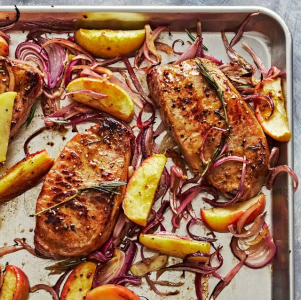
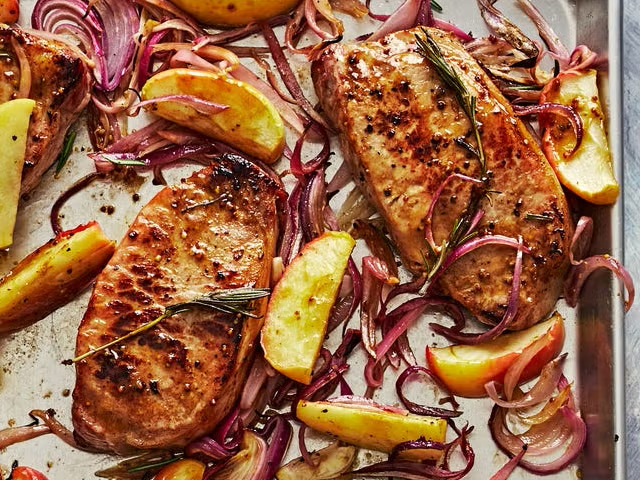
Today’s featured recipe is perhaps the easiest way to reacquaint yourself with pork. It’s a sheet pan preparation that takes minimum time and effort to prep. And maximizes the return in flavour and nutrition.
Those already friendly with pork will know that pork and apples are ancient and bosom friends. And the red onion, which also plays an important supporting role in the story, is an ideal accompaniment, providing a fundemntal savoury component. I recommend you also add green and red bell pepper spears (yellow, too, if the fancy strikes you!) to round out this one-pan meal into something like a fajita experience.
A simple seasoning of salt and pepper is enough to dress the chops, in the presence of those other flavours. But you may opt to add complementary herbs or spices. Go lightly. Give pork’s own unique, delicate flavour the chance to shine through!
My take
I’m well aware that some readers will have to pass-up participation in the Pork Renaissance due to cultural or religious prohibitions. So be it. But the rest of us really should dip a toe in the Pork Pool and test the waters – again, or for the first time!
~ Maggie J.