
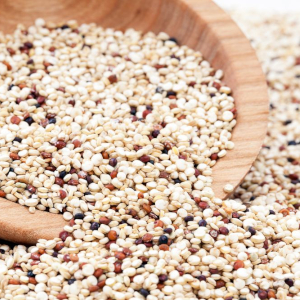
The FFB hasn’t touched much lately on the coming mass segue we’re facing, from animal protein to plant-based protein. But a new scientific survey makes it almost obligatory to report on additional benefits just discovered for Quinoa…
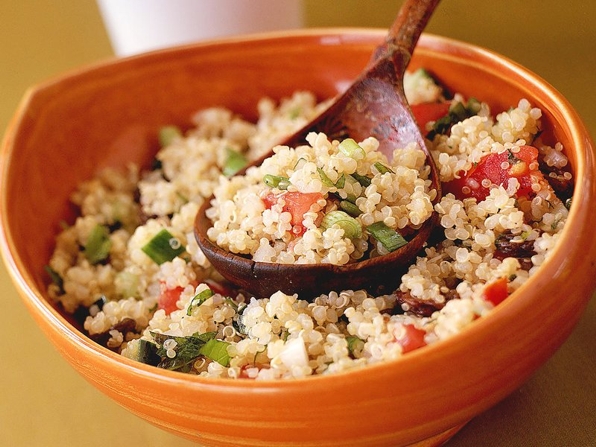 Quinoa Tabbouleh: A classic Middle Eastern staple updated and upgraded
– newstalgized! – by subbing-in Quinoa for the traditional bulgur wheat.
We already know – from reading many posts in this space – that Quinoa is one of a select few foods that provide vegetarians and vegans a complete dietary protein. No processing, augmentation or fortification. No need to team it with legumes. It’s darned near prefect just as it comes from the field…
Even better than we thought
Now, there’s new evidence that Quinoa is even better for us than we thought!
A recent survey of scientific literature published in Food Research International reveals a cornucopia of new benefits delivered by what is already considers by many to be a superfood.
‘The Mother of Grains’
“Quinoa, often referred to as ‘the mother of grains’ and ‘a gift from God’, has garnered significant at-tention for its potential health benefits,” the survey’s conclusion enthuses. “The nutritional profile of quinoa varies across its different plant parts, with quinoa leaves containing the highest levels of pro-tein and fibres, while germinated seeds are notably enriched with [beneficial] acids, minerals, and antioxidants.”
In less-flowery terms, Quinoa is, in fact, an ‘ancient grain’ which has come back into the scientific and consumer eye in recent years. It’s accompanied by other ‘forgotten’ grains such as millet, flax, teff, emmer, sorghum and amaranth. But none has received the attention that Quinoa has been accorded – both by science and folks looking for a new, healthy alternative to animal protein.
What’s new?
The survey revealed solid findings suggesting that Quinoa:
-
- Helps Regulate Blood Sugar
- Supports Heat Health
- Improves Gut Health
- Fights Inflammation
- Increases Absorption of Vitamins and Minerals
Quinoa is also gluten-free, making it entirely suitable for those with celiac disease or gluten sensitivity.
How to use it
The product packages seem to agree that 1.4 cup (60 ml) of dry Quinoa is a good single portion size. That translates to 2/3 to 3/4 cup cooked, depending on the method.
Quinoa comes in three colours: White, Red and Black. White is the most popular. When cooked it (ideally) has the texture of steamed rice and a mild, nutty flavour. Red Quinoa is a litle less tender and fluffy, but has a stronger flavour, ideal for pairing with other foods. Black is the ‘toughest’ of the three varieties, presenting an actually crunchie bite and a definite ‘separate grains’ mouth feel. It’s recommended for salads, soups, stews and ‘bowl’ dishes.
Some recipe ideas…
May we suggest so0me recipe ideas to help you get started with Quinoa?
Food & Wine contributor Molly McArdle has curated a comprehensive list of recipes that cover a wide variety of techniques and applicatio0ns.
And for total beginners… Here’s a reference on ‘How to Cook Light, Fluffy Quinoa Every Time‘…
My take
I’ve made Quinoa dishes a number of times. And I find I’m making more as time goes on – because I’m becoming more aware of just how versatile this supergrain is. McArdle’s recipe compendium should give you a head start on your Quinoa journey!
If you’re still squeamish… All I can say is: Try it! You WILL like it!
Maggie J.