
When artificial sweeteners started to flood the market in the 1970s and 80s, they immediately came under scrutiny. Since then, many have been condemned as unhealthy. Now, Sorbitol has been linked to demon fructose…
Fructose is a sugar found in fruits and veggies, which is widely used in processed foods from soda, to baked goods, to condiments, to dairy products. And it’s a leading offender on the excess sugar most-wanted list. It’s particularly vilified as an easily digested sugar which can lead to blood sugar spikes and contribute to obesity.
The ‘family’ connection
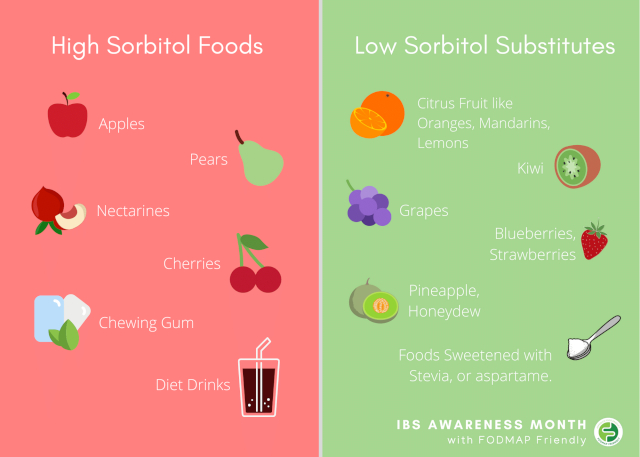
Sorbitol is an artificial sweetener commonly used many of the same products as fructose, and others including toothpaste and pharmaceuticals. It, too can be found in nature, in apples, pears, peaches, plums, prunes, cherries, apricots, and dates.
The problem…
Now, researchers have discovered that sorbitol can turn into fructose in the body, under certain cir-cumstances. Up to now, sorbitol ha been considered completely safe – harmless. But it appears that characterization may need to be rethought.
What they did
A team of researchers at Washington University in St. Louis wanted to find out how sorbitol is pro-cessed in the body. And they came up with some unsuspected and troubling findings.
Their experiments were conducted on fish. But the team says its findings probably translate directly to humans.
What they found
For one thing, the team found that sorbitol does not have to come directly from food. Enzymes in the intestine can also produce it from glucose after a meal.
Once sorbitol is present, its eventual fate can depend on how much glucose and sorbitol has been consumed and on the types of bacteria living in the gut.
“It can be produced in the body at significant levels,” says team leader Dr Gary Patti. “But if you have the right bacteria, [it] turns out it doesn’t matter.”
If you don’t have the right bacteria, sorbitol can be passed on to the liver, where it can be trans-formed into fructose. And that means trouble for diabetics and those trying to lose weight.
The takeaway
People with diabetes and other metabolic disorders may deliberately choose products labeled ‘sugar free’ in an effort to avoid the health effects associated with table sugar,” and abstract of the study report explains. “Understanding whether alternative sweeteners truly offer a healthier metabolic outcome is therefore important.”
My take
Here’s a classic example of the old ‘rule’ that, if something seems too good to be true, it probably is.
But somebody should have noticed that sorbitol is found in the wild in many of he same fruits as fructose. Certainly, I’d have thought some chemist would note a similarity in their molecular struct-ures. Maybe not. I’m certainly not a chemist.
My concern is that, for decades, folks who wanted to lose weight, and especially diabetics who want-ed to avoid sugar, have been choosing sorbitol-sweetened products.
The worst part is, for all those years, older science had tagged sorbitol as a ‘better’ alternative to sugar than other artificial sweeteners such as aspartame, saccharine, or sucralose…
~ Maggie J.