

2.1 min. read
If you are a chronic, addicted cup ramen consumer, science has dropped a yellow caution flag on your snack track… New research confirms that you’re getting elevated doses of microplastics from your cup noodles fixes – not from the noodles, but from the cups!
Scientists wanted to find out what happens when hot water hits plastic food packaging. Particularly with instant cup noodles. And they say you should be concerned about their findings…
Millions at risk?
Uncounted hundreds of mllions of folks – mainly in Asia – consume billions of servings of instant noodles each year. And they’re all at risk of taking aboard serious levels of microplastic particles, according to new research at Researchers at China Agricultural University in Beijing.
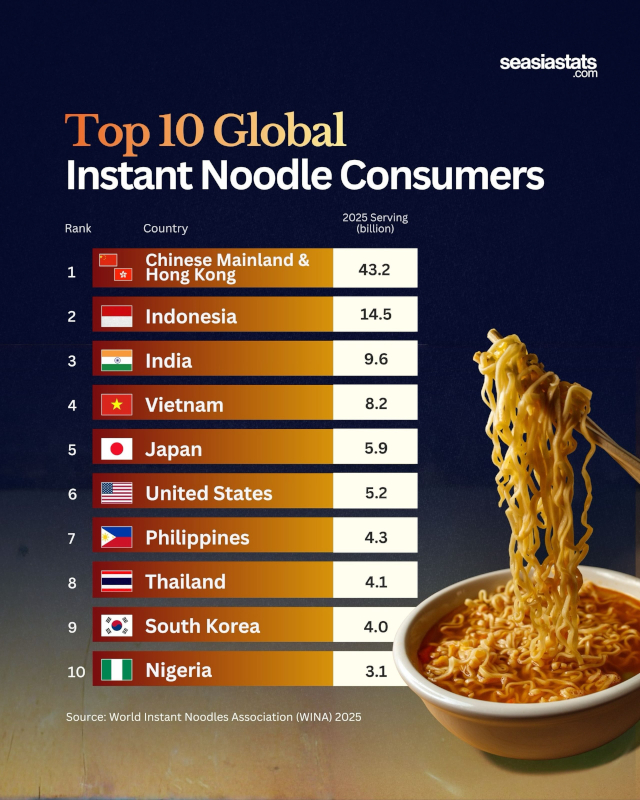
According to the latest statistics, folks in the Top 10 instant noodle consuming countries alone de-vour more than 124.5 billion servings of cup noodles in 2025 alone. China accounted for more than a third of that total. And the US even made the Top 10, placing 5th, at 5.2 billion servings. No other Western nations made the Top 10…
What they did
The experimental method adopted by the researchers was simple. They made cup noodles in the usual way, pouring hot water over the dry contents of regular, supermarket-sourced cups, stirring them, and allowing them to sit. And then screened them for microplastic particles…
What they found
The team found that all the brands they tested released microplastic particles into the food, some more than others. The average number of particles detected was 314. Which may seem a small num-ber. But the researchers only tested for particles down to 20 nanometres in size, which leaves a whole smaller universe of the contaminants unaccounted for.
The takeaway
So… If you consume one cup of instant noodles a day, you can expect to absorb at least 300 micro-plastic particles. That’s 114, 610 per year. Got a two-cup-a-day habit? That’s 229,220 particles per year. Three cups a day? That’s a serious sounding 343,830 microplastic particles!
Then consider that the average person is estimated to consume 39,000–52,000 particles a year from food alone (Cox et al., Environmental Science & Technology, 2019), and over 90,000 for people who mostly drink bottled water. The cup noodle vector turns out to be a significant source of microplastic ‘forever’ pollutants!
My take
“Plastic never goes away — it just breaks down into finer and finer particles,” Dr Desiree LaBeaud, a pediatric infectious diseases physician at Stanford Medicine who co-founded the university’s inter-disciplinary Plastics and Health Working Group, says.
Research on the health impacts of microplastics in humans is just beginning, a new Insight from Stanford Medicine reports. The particles have been found in multiple organs and tissues, including the brain, testicles, heart, stomach, lymph nodes and placenta. They’ve also been detected in urine, breastmilk, semen and meconium, which is a newborn’s first stool.
“We’re born pre-polluted,” LaBeaud notes.
How dangerous are microplastics? The Stanford report says more than 10,000 chemicals are used to make plastic. Two-thirds have not been assessed for safety. But over 2,400 are considered potentially toxic.
The bottom line
If you love your cup noodles, at least empty them into a glass mixing bowl before pouring the hot water on them. At the very least, don’t stir them in the cup!
~ Maggie J.