
3.0 min read
My answer is, resoundlingly, “YES!” Why I had never come across this method of preparing flawless, even fancifull Asian Vermicelli Noodles before, I’ll never know. But I’m on the verge of adding a new routine to my new plant-protein informed eating plan…
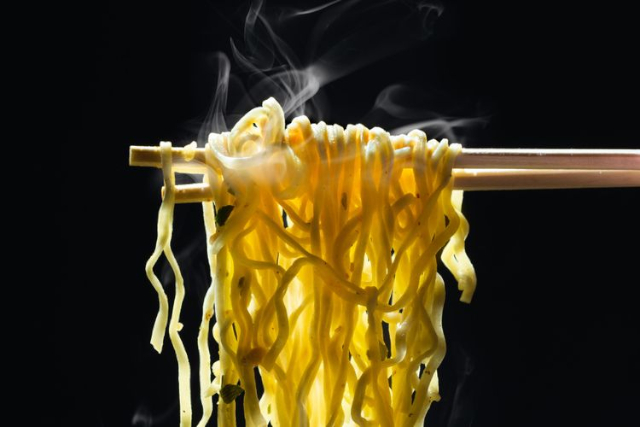
I’ve tried this easy, totally common-sensical approach to prepping wheat-based and even rice-based Vermicelli/Ramen noodles a number of times, now. And my efforts have been met uniformly with success… And sublime dining satisfaction.
Transformative
The experience has been nothing short of transformative for me. And a retro blast, as well!
It’s been transformative in that it’s reintroduced a long-neglected option to my monthly meal plan rotation: ‘Ramen and Whatever’. And that classic, upon which I once based my college-days diet, is now both in vogue and in the spotlight as an ideal to enjoy a plant protein…
Flashback…
… To my university career, and my friendship with Phil Chan, the Student Ombudsman on the Food Plan Committee. Phil introduced me to Ramen cup noodles decades before they became widely popular with college kids living away from home for the first time.
His family ran a chain of Asian restaurants Down East, and was branching out to manufacturing a line of prepared ‘American Style Chinese’ foods to sell in supermarkets. Foremost among them was a sel-ection of instant Ramens. Phil and I split cases of the stuff, sent up from Halifax by his thoughtful parents. We both experimented with additions and flavour mods…
A non-issue
Tips, hacks and tweaks to preparing the vermicelli were non-issues with cup noodles. But now-a-days, folks are rediscovering Ramen on a higher culinary plane. They’re making it in bowls, with their own broths and their own toppings, and taking more than a passing interest in the way the noodles turn out…
Enter, the soaking technique
We mentioned the ‘soaking’ procedure for perfect vermicelli a few weeks back. But it’s time to take a closer look, and refine our technique.
As you’ll recall, the so-called secret to perfect vermicelli noodles was not to cook them, as such. The ‘right’ way to prep them was to soak them in cold water for up to half an hour before draining and ‘activating’ them by adding them to the hot broth just before serving. That way, they neither came out too under-done, nor got mushy. The latter condition was easy to reach simply by allowing the noodles remain in contact with the hot broth too long, either while ‘cooking’ or waiting in the pot before serving.
Soaking temp is key
It’s become clear to me, after many ‘trials’, that the temperature of the water is critical to optimum results. The more research I did on the soaking technique, the more ‘options’ I uncovered. Some ‘experts’ said to use warm tap water. Others insisted that room temperature water was ideal. Still others said to use cold tap water. And extremists insisted that refrigerated or ‘ice’ water be used.
Well. I now consider myself something of an expert. And my considered opinion is that cold tap water is the ideal ‘solution’ – in every sense of the word.
You can’t leave the noodles in cold tap water too long, risking mushiness. The idea is for the pasta to absorb water gently and slowly, so as not to disrupt its structural integrity. And that process happens slowest and most gently in cold water. But refrigerated water – and certainly, ice water – both retard the absorption process excessively. Leaving even 30-minute-soaked vermicelli still tough in the cent-re. And by that time, the outer regions of the noodles are already saturated with water and can be-come mushy when shocked by the boiling broth.
My take
Here’s my personal, recommended, best-practices process for pepping vermicelli noodles for any application, but specifically for Ramen bowls.
Soak the noodles for 15 to 20 minutes in cold tap water. Drain well in a sieve or colander to remove as much of the cold water as possible. Then portion them into individual serving bowls. Finally, add the hot broth and allow the whole dish to come up to temperature for a minute or two. In restaurants, they know that the ideal resting time from douse to dining is the time it takes for the food to travel from the kitchen to your table..
I hope this revelation – based on the hard work and dedication of yours truly, and dozens of trials – all of which I heroically consumed to validate my observations by actual tasting – makes everyone reading this more heroic about prepping their own Ramen!
~ Maggie J.