
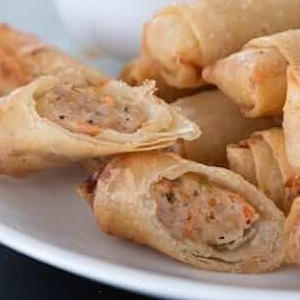
The name doesn’t sound mouthwatering. But the dish itself is an irresistible fusion of Asian food forms and ingredients that carnivores will crave. Lumpia is a beloved Filipino staple some folks make several times a week!
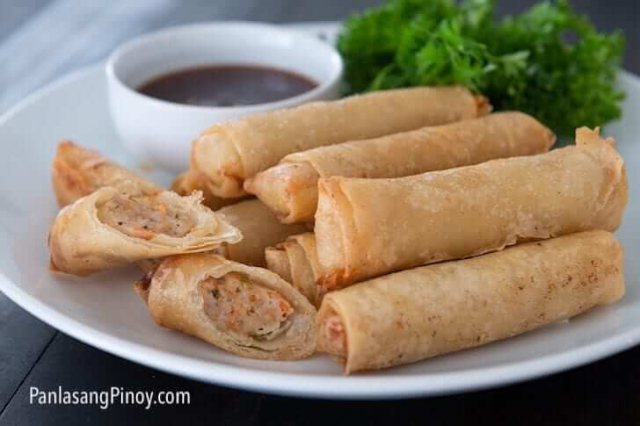
It’s not only a blend of Asian traditions, it’s a fusion with European classics. Think: a sausage roll wrapped up like a spring roll… And that’s an upgrade/update that qualifies this treat for newstalgia status!
A little background…
“Lumpia came to the Philippines through Chinese cooking, especially from Hokkien communities,” recipe contributor, Filipino native Vanjo Merano explains. “The word is Hokkien: ‘Lun’ means moist and ‘pia’ means pastry.”
In the Philipines, the old saying, ‘Variety is the spice of life’, is especially true…
“Lumpia can also be made with vegetables or served fresh instead of fried,” Merano explains. “Lumpiang Sariwa uses a soft wrapper and peanut sauce, Lumpiang Gulay is packed with vegetables, and Turon is the sweet kind made with banana.”
The classic filling
The classic meat filling makes a substantial main dish when accompanied by some authentic Filipino veggies or a salad. It’s essentially a simple, savoury sausage mix featuring ground pork, carrots and onions, eggs and garlic.
Merano wants you to use real Lumpia wrappers, if you can find them. The only difference I can see between them and standard spring roll pastries is, they’re a little larger. You should be able to get one or both at any good Asian grocery store.
It’s important to use a slightly-fatty pork cut – if you can’t get ground pork in the ‘meatloaf’ corner of your supermarket’s meat cooler. A little extra fat is essential to make sure the meat stays moist and juicy.
Tips and hacks…
Merano offers some quick tips and hacks to help you get the most from your Lumpia, and keep them as authentic as possible…
- Wrap them tight. A loose roll traps air, and can pop open or soak up oil.
- Do not overfill. One tablespoon looks like too little, but it is enough. A fat roll takes longer to cook and can stay soft in the middle.
- Keep them the same size. Rolls that are the same size finish frying at about the same time.
- Keep the wrappers under a damp towel while you roll, so they do not dry out and crack.
- Drain on a rack, not paper towels. On paper, the bottoms steam and go soft
- Mince the vegetables small. Big pieces stay raw, and can tear the wrapper.
- Always cook any version of Lumpia you’re making if the filling contains meat.
You can deep or shallow fry the Lumpia for 3 to 4 minutes at 375 F, as you find most convenient. If shallow frying, turn often to ensure uniform browning on all sides, and even cooking of the filling.
My take
Note that these little bundles of joy are meant to be served 3-4 per person, with enough left over from your big batch to ensure bigger appetites can get seconds.
Filipino sides you should consider include:
- Steamed White Rice is traditional. Or…
- You can also serve Pancit Canton (Stir Fied Noodles) – another Filipino staple!
- Sweet Chili Sauce and Banana Ketchup are also de rigeur.
You can freeze these guys in regular plastic freezer bags for up to a month. But considering how pop-ular they are, I can’t see any lasting that long… When you come to serve them, reheat in the oven on a parchment paper lined baking sheet at 325 – 350 F until the internal temperature reaches at 165 F.
And by all means, have seconds!
~ Maggie J.