
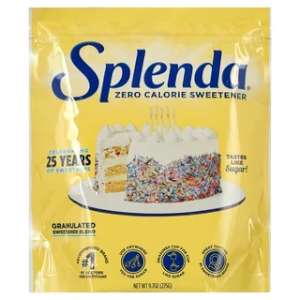
We’ve been hearing about ‘issues’ surrounding artificial sweeteners for a couple of decades, now. Only relatively recently have serious scientific studies been done. But the most recent, on Sucralose, has bolstered some truly troubling indications…
The researchers, from North Carolina State University, previously determined that a substance chemically similar to sucralose (the scientific name for the sweetener used commercially, and sold at retail as ‘Splenda’) can cause DNA mutations in mice. That’s serious, because mice, though they look a lot different from humans, have many genetic factors in common with us. That’s why they use rats and mice extensively in lab research.
What they found
The 2023 investigation focused on sucralose-6-acetate, a compound that is chemically related to sucralose but is not the same substance. It can occur during manufacturing and remain as an impur-ity in the finished sweetener. The NCSU researchers reported finding it at concentrations of up to 0.67 percent in commercial sucralose samples they analyzed.
But those experiments did not prove that ‘ordinary’ sucralose consumption was responsible for DNA damage they found in their test animals. As recently as earlier this year, European regulators con-cluded in 2026 that the sweetener remains safe under its currently authorized uses.
New findings
Now, though, the same NCSU team has found that sucralose may be getting broken down in the di-gestive process, possibly producing higher levels of sucralose-6-acetate in the body.
“Our new work establishes that sucralose-6-acetate is genotoxic,” the study’s corresponding author, Susan Schiffman, said, when the initial findings were announced in 2023. “We also found that trace amounts of sucralose-6-acetate can be found in off-the-shelf sucralose, even before it is consumed and metabolized.”
But those results were questioned. To address the challenge, Schiffman’s team recently conducted new experiments – this time on human cells cultured in the lab (not on actual people).
“In short, we found that sucralose-6-acetate is genotoxic, and that it effectively broke up DNA in cells that were exposed to the chemical,” Schiffman reported.
Still a grey area…
The issue of sucralose’s safety remains a grey area. The main issue there is what the ‘safe maximum daily dosage’ of sucralose should be…
“[T]he European Food Safety Authority has a threshold of toxicological concern for all genotoxic sub-stances of 0.15 micrograms per person per day,” Schiffman notes. “Our work suggests that the trace amounts of sucralose-6-acetate in a single, daily sucralose-sweetened drink exceed that threshold. And that’s not even accounting for the amount of sucralose-6-acetate produced as metabolites after people consume sucralose.”
My take
Too bad for sucralose and it’s promoters. The stuff has been a go-to sugar alternative since the 1990s, when it spread across the Western World.
One factor that distinguishes sucralose from other sugar alternatives is, it’s available in granulated form and can be used as a direct substitute in many baking and cooking applications. And that same granulated product has been sold in single-‘teaspoon’ packets as a beverage sweetener deployed in restaurants and institutional foodservice environments since 1999.
But the Splenda people have been hedging their bets, diversifying into sweeteners based on stevia, allulose and even monk fruit… So even if sucralose-based products were banned (admittedly, a long-shot) it’s likely that nobody would lose their job…
The bottom line seems to be… The additional research urgently recommended by the NCSU team in their latest report can’t come soon enough – especially for folks who’ve been using Splenda in their morning coffee every day for 20+ years…
***
A footnote: The official news release announcing the most recent findings of the NCSU team appears to have been removed from the link page on which it was originally posted… More intrigue, as more challenges are raised by other researchers?
~ Maggie J.
https://www.sciencedaily.com/releases/2026/09/260903064251.htm