
Second Harvest Canada has been rescuing leftover and surplus food for over 40 years. Last year alone, it rescued and redistributed 95.3 million lb of food. But the group says consumers have to start doing their part, wasting less…
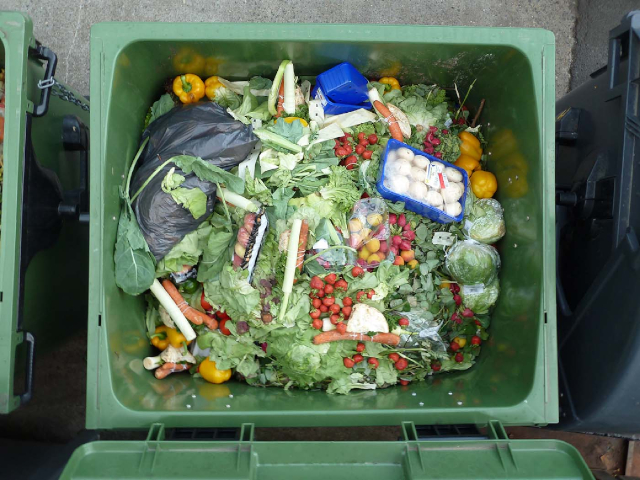 Typical household food wastage: We buy too much of it, plan too
little how we’ll use it. And throw away almost half of it…
Second Harvest’s Date Coding and Food Waste Research Report identifies an international move away from classic ‘Best Before’ dates. The new focus is on food safety…
A sharper focus
The new trend in labelling is not only a change on direction, but a sharper focus on food safety – one consumers can better understand in relation to their own experience.
We’ve previously shared folks’ issues with the current Best Before labelling system. In spite of repeat-ed coverage in blogs like this one and government initiatives to raise awareness of the system and how it should be used, many consumers still report they don’t really know what BB dates mean. Many of those confuse BB dates with Expiry dates.
Something better
Consequently, the Second Harvest Report suggests Canada adopt a new BB dating system. One bring-ing it in line with the rest of the world.
Canadian Grocer magazine says, “[The Report] notes Canada is falling behind peer countries like the UK, Australia, Korea, Japan and several EU nations that have identified date coding misinterpretation as a driver of food waste. These countries have begun modernizing their labelling systems as part of broader national food waste reduction efforts.”
Time is right
And the timing couldn’t be better. The federal government has just announced a sweeping probe of competitive practices in the Canadian Food supply chain. A parallel program to revamp and upgrade BB and Expiry dates, as associated labelling practices, may be just the thing to put the icing on the cake.
Lori Nikkel, CEO of Second Harvest, says, “Food waste needs to be a part of it. […] It’s a food system failure that we are losing all this food.”
Nikkel adds, Canada has a real opportunity to learn from countries that have already begun mod-ernizing their labelling systems. “Other countries are doing this, and doing it well.”
Basic changes needed
“Best before dates are about peak freshness, and yet they’re on everything,” Nikkel says. “They’re not about food safety at all.”At the same time, she points out, Expiry dates are required on only three products sold in grocery stores: baby formula, meal replacements and protein bars.
The first change, she says, should be to get rid of unnecessary BB dates.
“Canada wastes 46.5 percent of its food—down from 58 percent in 2019 – representing $58 billion of avoidable food waste,” Canadian Grocer reports. “Twenty-three percent (or $13.3 billion) of that waste can be attributed to misunderstanding of the meaning of ‘best before’ dates.”
‘Buy-in across the board’
Nikkel says a working group including Second Harvest, the Retail Council of Canada, various manu-facturers and major retailers last year investigated how the food date-coding system could be im-proved. The group’s findings and recommendati0ons were backed unanimously by the forum’s participants.
Their main recommendation was that ‘messaging’ abo9ut food safety labelling be stepped up in retail stores. Because that’s where food shoppers congregate, and where food is top-of-mind with them.
As simple a change in best practices – getting manufacturers and retailers to all use the same food-dating language – could be the key. “I think we would have a really good shot at changing the con-sumer understanding about what ‘best before’ dates are,” Nikkel says.
My take
I’ve been harping on this issue for years, lamenting the lack of understanding in the consumer cohort about food safety labelling.
If we could save more food from being wasted, it should bring the price down. That’s basic econom-ics. And it would help the environment, which is struggling under the attack by Global Warming.
In 2025, Second Harvest’s efforts alone averted the release of almost 140,500 tonnes of greenhouse gasses from rotting food waste in landfills. If we all knew what food safety dates really mean, we could double or triple that figure almost instantly….
~ Maggie J.