

I first tasted espresso at a small café in a sunny atrium in downtown Toronto. It was a treat from my first real boyfriend, on our first Saturday book store browse… Since then, I’ve wished I could have espresso without all the fuss…
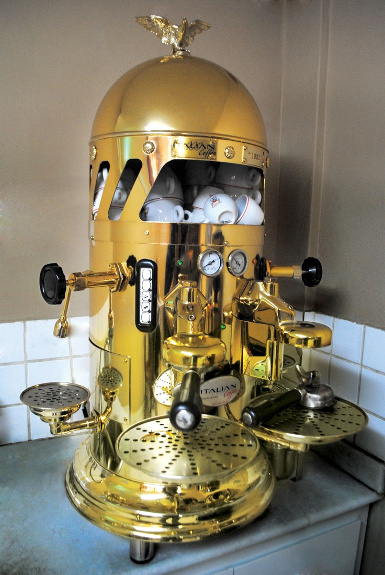
‘The fuss’ is amply illustrated by the vint-age Italian espresso machine pictured at left…
Just gimme my shot!
I drink my casual coffee black. In relative moderation. But when I want an espresso, I want it hot, rich – and fast. It’s ‘therapy’.
Alas, it takes many long moments to push that demitasse of concentrated caffein-ation out of a machine that looks like an oil refinery cracking tower, might stand over three feet (one metre) tall, and might require an engineering PhD to operate…
“What if,” I’ve asked myself many time, “there was a way to get the same blessed result faster and simpler?”
Science now claims to have found a way, using space age technology, to produce authentic espresso at the press of a single button…
A different buzz…
Folks commonly call microwaving something ‘buzzing’ it – homage to the buzzing sound the machines make. The espresso machine of the future might also buzz, but at a much higher frequency you prob-ably won’t even hear.
A new ‘vibe’…
You might more accurately call it a new ‘vibe’. The pivotal development, by Researchers at the Uni-versity of New South Wales (UNSW) is a method for brewing full-strength espresso using sound waves instead of heat and pressure.
That has some espresso purists steamed. And for good reason. But the implications of the discovery go far beyond your cup.
How it works
The process, using sound waves, is based on the same principles as hospitals use in their sonograph and ecocardiograph machines, navies use in their SONAR systems, and jewelers use to clean delicate baubles.
Applied to espresso, a patented brewing sonoreactor sends high-intensity ultrasound directly into a filter-coffee brewing basket during water percolation, using loosely packed ground coffee.
The result is a brew the researchers say was indistinguishable, chemically, from classic steam-forced espresso. And actually preferred over the same ground coffee brewed in a conventional ‘pour over’ filter machine.
On top of that, the ultrasonic method uses less than 25 percent of the energy required by traditional espresso machines.
The taste test
“Of course, making a concentrated coffee in the laboratory is one thing. The real test is whether peo-ple want to drink it,” Lead Researcher Francisco Trujillo, a senior lecturer in Chemical Engineering at UNSW said, in a statement. “So we ran a blind evaluation with around 100 regular coffee drinkers. They were not trained judges; they were everyday consumers who drink coffee at least once a week.”
“We served them four coffees in identical cups: traditional espresso, ultrasound-brewed espresso, traditional filter coffee and ultrasound-brewed filter coffee. All were freshly prepared, cooled to the same temperature and presented in random order. […] Participants could not reliably tell the tradit-ional and ultrasonic [espressos] apart.”
Broader implications
What the ultrasonic espresso system does is essentially speed up and intensify the process of ex-tracting coffee essences from ground coffee – a chemical reaction.
With that in mind, the researchers say their technique might also find applications in industrial pro-cesses, speeding up various types of chemical reactions, and dramatically reducing the amount of energy required.
My take
I’ll be first in line to grab a ‘home edition’ ultrasonic espresso machine when one comes on the market….
~ Maggie J.