
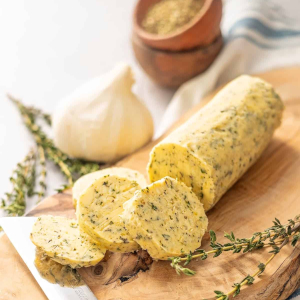
It’s dead centre of BBQ season and I’m getting more and more inquiries about an ancient and trea-sured tradition among Steak House kitchen stars: Chef’s Butter. Time for an update and maybe a newstalgic twist or two…
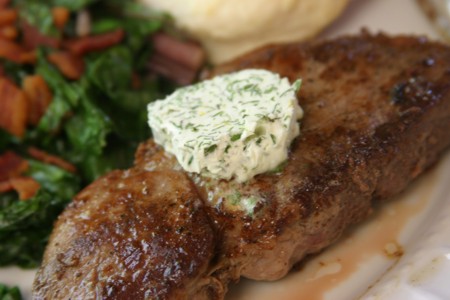 A classic ‘slicing’ strip loin with pat of whipped Sage, Rosemary
and Thyme Compound Butter on top as a finishing touch…
What is it?
The artists who lord it over the fires and gridirons of the world’s ‘best’ steak houses have a chef’s secret they rarely share with outsiders. Their personal, secret recipes for the Chef’s Butter that gives their creations the special finish people come hundreds of miles for.
A topic deemed worthy of a whole lesson when I was in culinary school rarely gets more than a few sentences of cursory explanation these days.
Chef’s Butter – a.k.a Steak Butter, a.k.a Herb Butter, a.k.a Finishing butter – is officially called Com-pound Butter It’s merely regular butter that’s been softened, mixed with a special blend of herbs (and sometimes carefully chosen spices), formed into a cylinder or bar, and placed in the bottom of the fridge to harden up again before slicing. For very special occasions, or as a signature novelty at certain eateries, it’s sometimes formed or moulded into trademark shapes.
I remember, when I was younger, a couple I knew having a fight over whether to get their names im-printed on pats of custom Chef’s butter for their wedding reception.
Flavour’s the thing
There are now compound butters aimed at enhancing desserts and sweets, but the ancient tradition focuses sharply on savoury applications.
In that family reside traditional flavours such as Lemon Butter, Garlic Butter, Dill Butter, and even Black Truffle Butter.
But more recent innovations include an even wider range of specialty butters featuring blends of two or more complementary flavours, intended use in specific applications. Even specific recipes.
A special place in their hearts
Seasoned grill aficionados have a special place in their hearts for certain Compound Butters they favour for key applications in their smoky realms.
I know one fellow who loves to entertain an audience around his grill, where he shares hacks and tips and secrets to the delight of all. He has a special Sage, Rosemary and Thyme Butter he uses as a finishing touch on his grilled beef creations.
There’s delicate, mysterious Garlic Tarragon butter he always keeps ‘in stock’ as a trademark touch for grilled veggies. This one is especially good on fresh veggies he’s seared on the bare grill, then foil-packaged to finish cooking to tender perfection. He just tosses a pat or two on the goodies be-fore sealing up the foil pack, puts the pack fold-up on indirect heat, and forgets it for half an hour so so.
For fish, he prefers a Lemon Dill Butter which he hints is a great way to avoid adding too much lemon or dill flavour that might otherwise overwhelm the fish itself.
Poultry screams out for his ‘Turkey Dressing’ herb butter, which features a carefully curated and por-tioned blend of sage, rosemary, thyme, bay leaf, and basil.
Tips and hacks
Courtesy of My Friend The Grilling Genius, herewith a few priceless Compound Butter tips and hacks…
If you have a Garlic Press and use it for nothing else, you’ll want it close by the grill to streamline and perfect the ‘mincing’ of fresh garlic for the preparation of Compound Butters.
Practice your knife skills vis à vis mincing and crushing (mainly seeds).
Practice stripping herbs such as Thyme and Rosemary off of their stems before mincing them.
Advanced techniques
Say you want to create a Compound Butter for a dish that calls for Cilantro. Be sure to use the fresh herb. If you are creating a Butter to toss into an Asian-style foil-wrapped whole fish where Coriander is called for, be sure to use the whole or crushed seeds from the same plant.
If you are incorporating chili peppers in a Compound Butter, use the dried form of the type of pepper called for, and remove the seeds before crushing the remainder of the peppers to flakes. Always measure the ‘cleaned’, crushed pepper flakes in standard kitchen measuring spoons filled just level to their rims. Do not compress the flakes!
Make your compound butters a day or so ahead to give them a chance to thoroughly harden up again in the bottom of the fridge before serving.
My take
Have fun with both the flavour and appearance of Compound Butters throughout the grilling season!
~ Maggie J.