
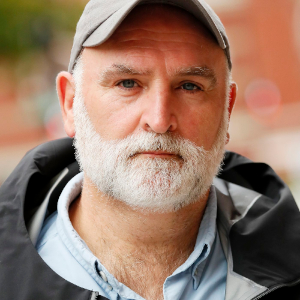
When disaster strikes, World Central Kitchen (WCK) mobilizes. And its founder’s, chef José Andrés’ philosophy of food guides the organization. For Andrés, the most important aspect of any disaster – natural or man-made – is ‘seeing the humanity’ above the politics…
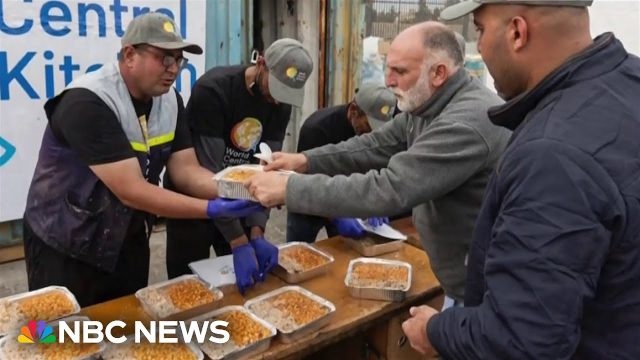 Andrés (second from, right) working on the front lines at
the latest incarnation of the Gaza WCK mission…
I try to avoid the descriptor ‘celebrity’ when writing about Chef José Andrés. He’s much more than that. To some, he’s a hero. To others, he’s more like a saviour. Because he and his monumental relief organization arrive on the scene of disasters large and small to make sure their victims don’t starve, while the local authorities are struggling to meet the ‘immediate’ challenges.
Blessed are the feeders…
Andrés likes to quote both the Book of Matthew in the New Testament, and the hadith (teachings) of Imam Ahmad ibn Hanbal.
Matthew 25:35-37 says, “For I was hungry and you gave me something to eat…” It’s the start of a list of acts any of us can perform for others, demonstrating grace, charity, and ‘justice for all’.
At the same time, he quotes Imam Amad, who said, “The best of you are those who feed others.”
That’s typical of Andrés. He doesn’t take sides – ever. Unless you count the third side in natural dis-asters and conflicts – the victims. And they can come from all sides…
Nobody wins…
“No one wins in a competition of suffering,” Andrés pointed out last summer, when most of the Israeli hostages were still in Hamas’ hands. And almost a million Gazans were starving. “It is time to end indifference, it is time to prioritize the return of the kidnapped and support the best manifest-ations of humanity in Gaza – not just hate the worst of it.
But Andrés doesn’t get any further than that into the political realm. He keeps his sights clearly fo-cused on his goal: feed the hungry.
But he has realized, given his broader scope of vision, what it will take to achieve peace in the Middle East.
Leaders must ‘see humanity’…
Of the Gaza situation in particular, and such conflicts in general, Andrés observed: “There is great suffering on all sides. Everyone is grieving, or knows someone who is.” The WCK ‘family’ was no ex-ception: “We are still grieving the loss of our seven friends in an Israeli airstrike last year.”
“Nobody wins the competition of suffering. Peace in Northern Ireland, like peace in the Basque Country, only came when leaders were willing to stop scoring points and start seeing the humanity standing in front of them,” Andrés reminds us.
My take
Andrés is right. The only way to resolve political disputes driven by hard-core leaders on both sides is to unify the people. H.G. Welles knew that when he wrote The War of the Worlds, (1895 – 1897). And that was well before the Cold War (1946 – 1991), which was often seen as Welles’ prediction…
Welles’ way to unite all the people was to set them a common foe from outside their own realm. He chose a Martian invasion. For folks who read his masterpiece today, it hammers us on the head with his message. But that’s obviously what the author foresaw would be needed to get it across.
Andrés, I think, is hoping that the leaders in today’s almost-perpetual conflicts will finally see that humanity must take precedence over politics or personal ambitions. I support him wholeheartedly. But I fear his vision will be a long time in coming…
~ Maggie J.