
It’s apple season. Every recipe website is offering armies of Apple Recipes, both new and traditional. And all the sites have their own idea of what’s the best apple to cook with. That wasn’t an issue when I learned to bake…
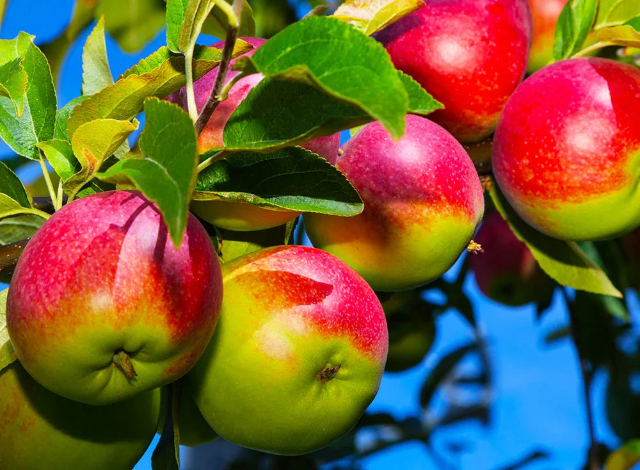 MacIntosh Apples: The opriginal all-purpose Apple and still the most popular!
It should go without saying that the type of dish you’re cooking will determine the type of apple you use. And experienced Apple cooks will often opt for a blend of varieties to get the exact flavour and texture they want…
Used to be easy…
When I was learning to bake, at my Mom’s knee, I had to stand on a little step-stool to work at the kitchen table – let alone the regular countertop. But I managed to get a lot done, and learned a huge amount about the chemistry of baking and the characteristics of the main ingredients involved.
One of the lessons on the board, at this time of year, was how to choose your apples for… A pie? Apple Sauce? Apple fritters? Whatever…
Back in that day, we had three types of apples available to us – for baking cooking, and eating.
Macs and Snows and Spies… Oh my!
MacIntosh
The classic apple variety everybody still loves – and considers the ultimate fallback position when cooking with the fruit. Like the all-purpose, or chef’s potato, the Mac can play on all the stages. But it’s not the first choice of cooks and bakers.
Snow
The Snow was a beautiful red apple with snow-white flesh. And it was the softest, sweetest apple of the three. It was the go-to choice for apple sauce or apple butter.
Northern Spy
Th Spy was a hard, greyish-fleshed apple with a super-crispy bite and tart flavour. It was prized for baking, when you wanted your apples to retain their structure in the dish. Like a really great Apple Pie… The lady across the street made Candy Apples for Hallowe’en. She always used Snows…
Mixing and matching…
For pies and associated applications, we used a mix of Macs and Spies, in various ratios depending on how the specific batch in front of us tasted.
For Applesauce and Apple Butter, we used Snows and Macs, to arrive at the best flavour, on the sweet side.
For fritters, we used Snows alone, for their sweetness. And because they didn’t need much cooking, they formed little super-sweet ‘applesauce’ pockets all through the pastry.
We never ate a Spy or a Snow as a snack.
Then came the flood
The first trickles of the flood of new apple varieties came during the 1970s… Granny Smith led the way, with Red and Golden Delicious close behind.
Since then, dozens of new apples have emerged from the greenhouses and orchards of avid cross-breeders, trying to create the ultimate eating apple that’s also great for cooking.
 Let me share a little secret…
It doesn’t exist! The sweetest varieties are all (and always) too soft for solo baking. The most resilient varieties are either relatively shallow, or extreme in flavour, on the tart side.
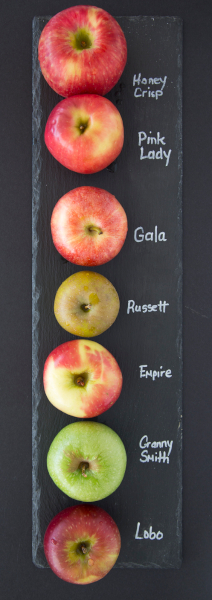
But that didn’t stop Cindy of saltandserenity.com from testing and ranking 7 of the most popular newer apple varieties (pictured, left) for their suitability as cooking apples.
Russets were no. 1 on the list. While they had all the necessary characteristics of a good cooking apple, they did have issues which would have lowered their score as a snacking apple, including a thick, tough skin and a lack of juice compared with Honeycrisp.
“When baked, the russet apples were not as meltingly tender as the Honeycrisp, but I really enjoyed their more gently yielding texture,” Cindy opined. The flavour of the russet was the most complex and balanced of all the apples I tasted. Slightly sweet but with a bit of tartness.”
Cindy put Honeycrisp as the second place. “These are my favourite apple for eating out of hand. They are shatteringly crisp, juicy and slightly sweet,” she reported. “When we baked them, they held their shape, but just barely. They literally melted in the mouth. The apple flavour was complex. I liked it, but found [it] to be a bit too sweet.”
Granny Smiths came in third as cooking apples. They are – as any apple lover will know – on the hard side and tart in flavour, though not overwhelmingly so. For me, Granny Smiths compare with MacIn-toshes as an all-purpose apple.
The rest of the varieties tested all had unforgivable flaws in flavour or texture. And as such, were branded ‘Don’t bother’…
My take
I’d still be cooking with Macs, Snows an Spies exclusively – if the latter two varieties were still avail-able. But apple growers have succumbed to the glamour and glitzyness of names such as Pink Lady, Gala and Honey Crisp. And the vast orchards of the old varieties that once blanketed the countryside have been ripped up and replanted in newer types.
I will admit that I have recently decided that I could easily substitute the Granny Smith in any role formerly played by the Northern Spy. With the addition of a little sweetener. And I really do like the Honey Crisp as a snacking apple. But It could also fulfill the obligations of the ancient and venerable Snow in any of my legacy recipes…
You’ll have to decide for yourself, which apples among those currently available suit your needs and tastes best!
~ Maggie J.