
This post will not be exactly what I’m sure you’re expecting after that headline. But it will cover the ground you expect it to traverse – part-and-parcel of a rant about ‘entitled’ young writers who point out the obvious to their readers…
Disclaimer: By ‘entitled’, in this post, I am referring to young folks with a bunch of ‘learned letters’ after their name who think they know it all. But have little or no real life experience. And assume that every new discovery they make about the world is new to everybody else…
Culinary case in point…
The headline read: ‘Never buy fresh blueberries if you spot these 4 warning signs’. I wondered what new cautions anyone who claimed to be an authority could offer about buying fresh berries of any kind? So for that reason, and that alone, I read on…
Who wrote it?
The story was showcased on MSN after someone there discovered it on Health.com, it’s origin point. Health.com bills itself as, “a publication focusing on a healthy lifestyle,” whose mission is, “to inform and empower you with accurate, empathetic, and actionable health information so you can make the best choice for your health.”
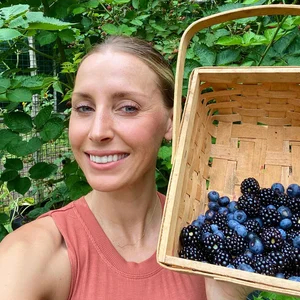
Fair enough. But I wondered who, precisely, author Jillian Kubala, MS, RD (see photo, top of page) was aiming her article at. You’ll see why in a minute…
What she said
The idea was to inform readers about how to tell a good box of berries from a bad one. Again, fair enough. But anyone who buys any kind of berries regularly knows the ins and outs.
Kubala proceeded to list 4 warning signs…
- #1: Mould On the Berries
- #2: Soft, Mushy Berries
- #3: Excessive Moisture
- #4: Sour Smell
My first thought was… Wouldn’t any of those ‘signs’ immediately tell anybody choosing any kind of produce that something was amiss? So what’s the point of building a 700-word post around them?
Pretty much redundant
The whole article was pretty much redundant to anyone with any interested in blueberries at all. I’ll admit I (uncharitably) mused that it should have been titled: ‘Blueberries For Dummies’…
My take
And that just proves my point. A venerable old saying reminds us, “Schooling simply teaches us how to spell ‘education’.” And that’s why we (ideally) allow only well-educated, experienced adults to teach our children. And young entrepreneurs seek older, wiser, more-experienced folks serve as mentors.
But young professionals are another case altogether… If they hang up their ‘shingles’ right out of university, they miss an enormously valuable experience: exposure to those in their line who have gone before them.
That’s why lawyers must ‘article’ with older, more experienced litigators. Add doctors must ‘intern’ under their seniors for 7 or more years before officially ‘entering practice’. Newly-minted accountants have to serve an apprenticeship with older, more experienced practitioners of their art before getting their licenses to go ‘solo’ out in the real world. Heck… Plumbers, electricians and other trades people – even chefs – all have to apprentice to earn their professional certifications.
Journalism is a profession…
Food writers – especially those who purport to convey health and wellness advice – should have to go through some specialized training, or at least spend time under the wing of experienced elders in their business, before being let loose on the world.
Kubala’s writing is adequately journalistic – not merely a textbook treatise on the subject. Nothing she said was incorrect or misleading. But she didn’t attribute the information to official, authoritative sources. Sure, she has an MS, and is a Registered Dietician. But as a learned person with those cred-entials, she should know the importance of backing up the facts she quotes with the best certificat-ions she can cite. A little journalism training could have remedied that oversight.
One final thought: Kubala’s presentation lacks a personal tone and audience-embracing ‘feel’. The latter being something good food writing should always strive for. But she’s still young and has lots of time to hone her craft…
~ Maggie J.