
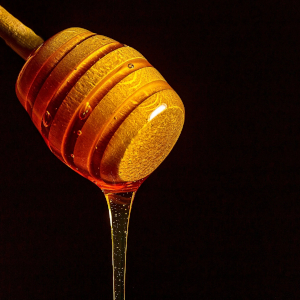
The situation has far-reaching implications. And could result in food shortages, with prices rocketing even higher. Beekeepers across the US and Canada are in what they call a colony collapse crisis. Crops that need to be pollinated are at risk…
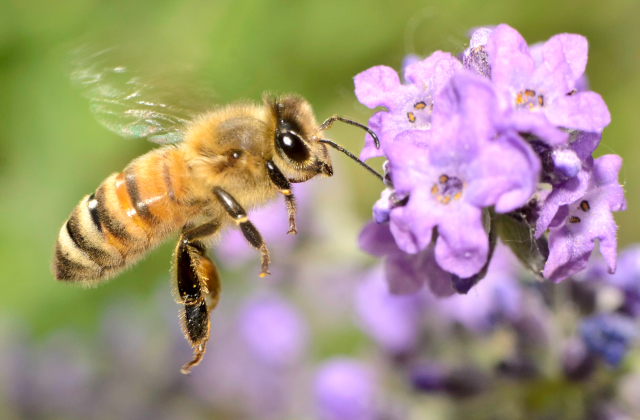 A Honey Bee: Apis Melifera Ligustica. The average worker bee makes only 1/12 of a
teaspoon of honey during her lifetime. It takes 2,000,000 bee trips
from hive to blossom to produce 1 lb / 445 g of honey…
But there’s more to it than that – a whole separate but parallel dimension that also directly, and immediately, effects consumers. Honey lovers, to be precise…
A byproduct
Honey is really just a byproduct of the huge industry that provides trillions of bees annually to pol-linate more than 1/3 of crops across North America. Without pollination by bees, crop yields would plummet and we’d all be reduced to starvation.
But Honey has an ‘economy’ all its own, unique to its special position in the food chain.
Colony collapse crisis
The bee keeping industry is in the midst of a crisis that’s already killed up to 50 percent of commer-cial colonies. It’s the result of an infestation by bee-targeting Varroa Mites combined with pesticide exposure, commercial pollination practices, and climate change. And the result of that has been a drastic reduction in domestic honey production.
According to the USDA National Agricultural Statistics Service, The US produced 116 million lb / 52.7 million kg of honey in 2025, down 14 percent from the previous year. But Americans consume an est-imated 550 million lb / 250 million kg annually. Where is the honey to fill the gap coming from?
A two-edged sword
There are two main vectors on which extra honey comes into the North American Market. One is illegal. The other can be bent to illegal uses by counterfieters. and adulteraters.
Imports
It’s only natural that extra honey to fill the expanding demand will be imported from global produc-ers. Alas, much of that honey is of questionable quality. Some is not what it’s claimed to be on the label. Some is from inferior producing areas rather than the premium producer claimed on the label. Some is diluted with cane sugar or other, cheaper sweeteners. It’s a lot like the counterfeit Olive Oil or fake Maple Syrup grey markets…
Domestic dilution
Some domestic producers resort to the tactics similar to the crooked sources supplying imports to North America. But their motivations are slightly different. They dilute their Honey to try and take advantage of the shortfall in actual domestic production.
Unlike foreign suppliers cheating North American importers and consumers, these guys are doing what they’re doing at home. And they can consequently be charged with fraud and various food-adulteration offenses if caught.
Small operators especially vulnerable
‘Earlier warm seasons are causing swarming, natural colony splitting where part of the colony flies away with a queen, resulting in decreased honey production. Droughts have also reduced bee for-aging ability because flowers are simply unavailable, prompting keepers to supply colonies with supplemental feedings, which are expensive.” Bob Gilbert, a board-certified entomologist and Staff Entomologist at Blue Sky Pest Control, told Food & Wine.
“These factors, coupled with the need to make a large number of replacement colonies to replace the dead ones, have created a situation where it is difficult for [some smaller] keepers to remain profitable,” he adds.
My take
If you are one of the many folks who care about what they’re putting into their bodies, and have been using honey as a ‘healthy’ replacement’ for sugar, you may want to pay more attention to the honey you’re buying. Unbelieveably low prices may be a danger signal. ‘Off’ flavours may indicate adulterated honey.
Buy locally if possible.
I’m lucky, in that I have three small apiaries within a 10-minute drive of my home, here on the out-skirts of the city. These small producers are in it for the honey, are jealous of their reputations, and are proud of their products. And I gladly pay a little more to be sure what I’m getting is the real deal.
~ Maggie J.