

There are traditional foods and culturally favoured foods… But some dishes transcend the everyday and become beloved national institutions. So it is with Jordan’s national dish – Al Mansaf. It’s a univ-ersal symbol of unity and social cohesion…
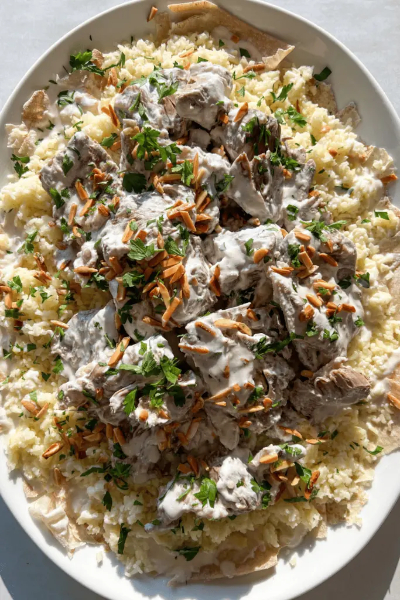
Al Mansaf is found at virtually all cele-brations – of any kind – in Jordan. It holds a unique place in the cultural fabric, having come up largely un-changed through millennia from its Bedouin creators to the present day.
The dish is officially described thus: “Large chunks of sheep or goat meat are boiled with spices in a yogurt sauce and served with rice or sometimes bulgur over a layer of thin bread. The prepar-ation itself is a social event, with cooks discussing common concerns, telling stories and singing. The layers of bread, rice and meat are arranged on a platter and garnished with fried, desiccated almonds. In northern Jordan, fried bul-gur balls filled with minced meat are also placed around the dish.
Has it’s own ceremonials
“The host’s relatives carry the platters to the reception hall and the guests sit around them, with five to seven people around each platter. Traditionally, the dish is consumed with the right hand while the left is placed behind the back*, but today some people use dishes and spoons,” the UNESCO World Heritage web page continues.
“Women generally pass down the recipes and related practices (such as milking the goat or sheep) to their daughters and granddaughters. Culinary institutes and universities also contribute to the dish’s transmission.
The recipe source
I’ve taken some pains in researching this authentic, traditional recipe for Al Mansaf. It’s from a young cook who received an indoctrination in both the technique and culture of the dish from her female family forbears… ‘Heifa’ says her goal in blogging, “is to make Palestinian and Middle Eastern cooking approachable for everyone, whether you’re familiar with the cuisine or just starting to explore it. I want to help you feel confident in the kitchen, so you can share these flavorful dishes with the people you love.”
How it’s made…
You prepare this special meal in three parts: The Lamb, the Sauce and the Rice. Heifa provides a de-tailed guide to what you should be doing, in all three parallel timelines, as you move through the prep. Don’t be intimidated. There’s nothing frantic or urgent in the process. When you get the hang of it, it’s kind of like the way your grandmother used to seemingly ‘breeze’ through making Thanksgiving Dinner without breaking a sweat…
The lamb is boiled in a hearty brew flavoured with whole cardomon pods, Basil leaves and onions.
The sauce is the most finicky affair. But it’s what makes the dish so special. It starts with Jameed, a hard, dried yogurt you don’t find anywhere but the Middle East. And includes regular thick yogurt and lamb broth. If that sounds like a lot of liquid, consider that you simmer the sauce for a fair amount of time, during which it reduces. And you add a cornstarch near the end to thicken it to the desired, gravy-like consistency.
The rice is elevated from the everyday with the addition of turmeric. And it’s cooked in lamb broth.
My take
Serve as directed by UNESCO (top of post), and make sure you invite lots of family and friends… Try to get authentic Sharak flatbread (available at most Middle Eastern Grocery stores) to keep it truly authentic!
~ Maggie J.
* An Arabic coworker of mine once warned me to ‘mind my left hand’ if I was ever invited to dinner at an Arabic home. “There’s only ONE thing we use our left hand for. And it is, literally, the farthest thing from putting food in our mouth!”