

I am compelled to draw your attention to a new CNN feature essay on the ancient and venerable British tradition of Afternoon Tea. Never before have I seen such a comprehensive take on the institution, complete with history, customs and a glossary!
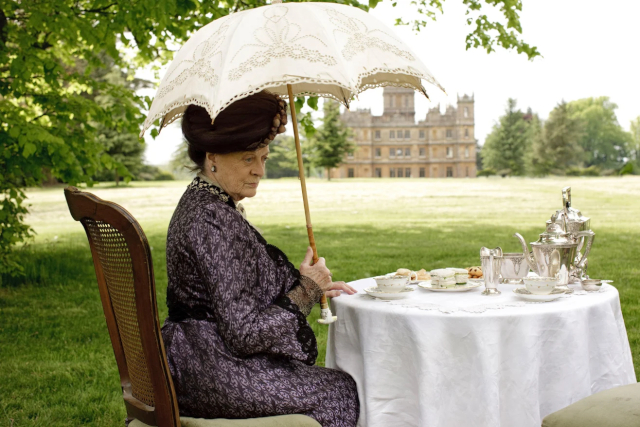 The Dowager Countess of Grantham (played by Maggie Smith)
tucks into classic afternoon tea at Downton Abbey…
Most everyone over the age of 10 in the Western World (and many elsewhere) know about the British institution of Tea Time. It’s like a second (light) lunch or an early (light) supper…
More objectively, it’s a mid-afternoon ‘break’ for Tea, sandwiches and desserts. For some, it’s an essential refuelling to carry them through to the traditional (later) Brit supper, rarely served before 8 p.m.
A little history…
British Society received Tea, and by association, Tea Time through it’s imperial domination of India. Brit administrators, military members and merchants who ventured ‘out’ to the subco9ntinent quickly learned that drinking hot tea made them perspire, which cooled them down – a defense against the torpid tropical weather.
And they brought the custom back with them when they came home – in their thousands.
It was originally a middle and upper-class ‘thing’. But today, everybody ‘takes tea’. Collective labour agreements include clauses guaranteeing it to workers the way North American employees get coffee breaks built into their contracts.
CNN feature writer Will Noble explains: “High Tea – because it was consumed during the late, or ‘high’ point of the afternoon — became a well earned respite for Victorian workers after a back-breaking day’s toil. Alongside steaming cups (or often mugs) of tea, robust delicacies were served: anything from parsimonious slices of buttered bread, through to cheese, pork pies and hams.”
The upper classes ate less amply, favouring dainlty sandwiches, bread and butter, jam and scones, fancy cakes and cookies. More than hors d’oeuvres, less than a real meal.
International visitors still find it a remarkable that, when they visit British homes and even many businesses, the Mother or proprietor, “was just putting the kettle on.”
Social interaction
In many homes and break rooms, there’s more talk than tea. Tea Time is an eagerly awaited point in the day where friends and family can interact with those close to them. But strict rules were always to be observed. More important at the upper levels of ‘civilization’ than at the lower, working class base, of course
According to Mrs. Beeton, the leading etiquette maven of the Victoria period, “There is very little art in making good tea.” Maybe. But she felt it necessary to follow that statement with another 600 words of detailed instructions.
Lady Constance Howard’s prescriptive Etiquette: What To Do and How To Do It” warned that, “Ladies intending to eat ice, cake, bread, etc. should take off their gloves, but gloves can stay on if one is only drinking without eating.”
Myriad variations…
Marketing types have come up with an almost endless list of Theme Teas. There are teas themed after literary lights (real and fictio0nal) such as Sherlock Holmes, William Shakespeare and Alice In Wonderland – in which the Mad Hatter observes: “It’s always Tea Time…”
Kids can tuck into special Teas celebrating Paddington Bear, Peppa Pig, Harry Potter and even Jurassic Park. London’s Science Museum’s afternoon tea gets children sipping from petri dishes.
British Airways serves it’s own version of Afternoon Tea in First Class, though not as posh as it once was, before inflation. As of this past September, BA announced it was cutting Clotted Cream and Green Tea Foam from its onboard Tea menu, triggering outrage among frequent high-flyers.
My take
My Maternal Grandmother often remarked that many a petty dispute was resolved over a comforting cuppa. Maybe the UN should institute mandatory Tea Breaks for its highly pressurized, knit-browed diplomats. There might not be so much trouble and travail in the world…
~ Maggie J.