
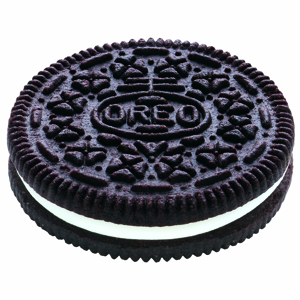
OREO Cookies have been around for 124 years! But did you know that the ‘classic’ OREO was not at all like the one we love today? The Chocolate Wafers have not changed much… But the filling sure has – in attempts to create a confection everyone could enjoy…
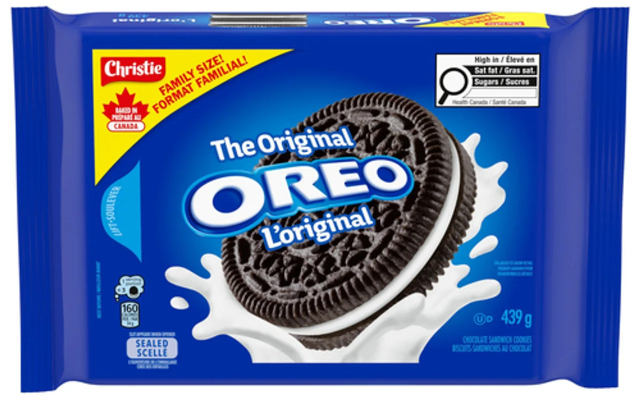
The ‘stuf’ inside your OREOs has undergone many recipe updates over the years. Some out of necessity, others out of a desire to appeal to a wider audience…
In the beginning…
Oreo received the Guinness World Records title as the world’s best-selling cookie on November 21, 2011, upon surpassing 500 billion in total sales. That’s 500,000,000,000 cookies! And I know I ate my share (at least), helping the truly iconic brand reach that historic moment.
I only just discovered, in research for this post, that there were two OREO flavours in the beginning: The one we know today as the original, plus a lemon meringue version. And you thought OREO’s penchant for launching new flavours, and teaming up with all kinds of other prodycts and enter-tainment icons was a recent ‘thing’!
What’s in a name?
The ‘OREO’ moniker has stuck since the beginning. But the modifiers Nabisco, and now Christie’s, have used on the label have evolved considerably. The cookie was originally called, simply, the ‘OREO Biscuit’. Less than a decade later, the name was updated to ‘Oreo Sandwich’ – the genesis of the now generic term ‘sandwich cookie’. In 1937, it became the Oreo Creme Sandwich. Finally, in 1974, they put it all together as: ‘Oreo Chocolate Sandwich Cookie’.
And today, they simply call it ‘The Original OREO’…
Secret’s in the ‘Stuf’…
They still call the basic OREO – sweet, rich Vanilla cream sandwiched between two deep, dark choco-late wafers – the ‘Classic’ and the ‘Original’. But many changes – some subtle and others not so – have taken place in the recipe over the years. Setting aside minor tweaks to the wafer recipe, we can still dedicate a whole post to the changes that have rolled over the filling formula.
But the original recipe has changed in significant ways.
“For one, […] the original recipe for Oreo cookies […] included lard or pork fat, making them inacces-sible to those who don’t consume pork or animal byproducts,” Tasting Table reports. “It wasn’t until the ’90s that the company replaced lard with partially hydrogenated vegetable oil and attained a Kosher certification.”
But then came the ‘no saturated fats’ revolution…
“Albeit a largely lauded decision at the time, this [vegetable oil] update was called into question in 2006, when concerns over trans fats were at the forefront of public discourse. This led the brand to replace the partially hydrogenated vegetable oil with a blend of palm and canola oil. Additionally, modern ingredients in today’s OREO cookies include high-fructose corn syrup, riboflavin, and thia-mine mononitrate, which were not yet available,” when the first OREOs were baked.
Ironically… Those ‘new’ ingredients are now coming under fire from doctors and nutritionists – not to mention clean food advocates – as being hazardous to our all-too-precarious health!
One more thing…
There’s a long-standing, ongoing debate among OREP fanciers about the alleged ebb and flow of Stuf in their fave cookie over the years.
The thickness of the icing layer in the OREO was standard and immutable until 1974, when Double Stuf version came on the scene. Since then, aficionados have complained that the Stuf layer has thin-ned out – accusing OREO of shrinkflation. And that doesn’t count the questionably popular OREO Thins…
OREO, however, insists the wafer-to-Stuf ratio of the Original OREO has remains locked at 71 pecent to 29 percent.
My take
I have to admit, I’ve never noticed any change in my OREOs over the years. The iconic flavour and the trademark twist-and-dunk routine have remained an anchor in my psyche – against the constant on-slaught of a Future Shock world where the even the pace of change is changing, for the crazier…
~ Maggie J.