

Whether you call it Kue Dadar Gulung or Kuih Ketayap, you’ll love this Sumatran sweet. As befits its place of origin, its a rolled pandan-infused crêpe is stuffed with coconut, coconut sugar and coconut milk!
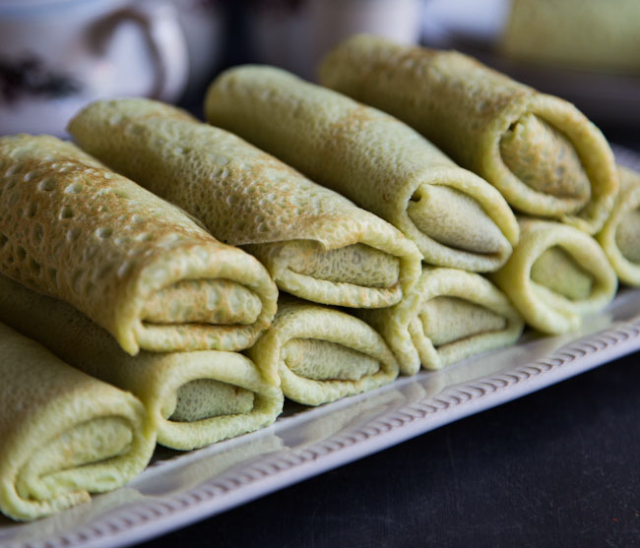 Beautiful Dadar Gulung: With the coveted bubbly crêpe texture…
The filling is the star in most stuffed desserts. But with the beloved, ancient Dadar Gulung, the soft, pale green, aromatic pancake wrapper that makes just as many headlines…
Much ado about batter
Recipe contributor Mavellina leveraged her Indonesian heritage to the max to make her version of the Dadar Gulung easy for you to reproduce, yet remain as authentic as possible. It takes some time and tinkering. But once you taste it, you’ll agree that all the fussing is worth it!
Marvellina admits she spent some serious time perfecting the formula for the crêpe wrapper using regular all-purpose flour, rather than the traditional tapioca or sago flour.
But other Dadar experts insist you should try to get some tapioca flour. Just a tablespoon or so in the regular wheat flour can make a real difference, producing an even-more authentic pillow-soft, chewy ‘bopeng’ pancake.
The filling
Coconut is ubiquitous throughout Indonesia, and it comes up in both sweet and savoury dishes. But if you were expecting a snow-white grated-coconut filling, you’re in for a (pleasant) surprise!
The mixture of coconut, coconut milk and coconut sugar called for in Mavellina’s recipe cooks up- into a semi-transparent, gooey-delicious ‘jam’, coloured a deep reddish brown, thanks to intense caramelization. And you have to taste the finished product to fully appreciate the ‘swumami’ good-ness it delivers!
You can get pandan leaves and coconut sugar at any decent Asian grocery.
Secret’s in the folding…
If you’ve ever tried to roll an egg roll or spring roll, or fold a crêpe for a fancy dessert, you’ll already know how maddening it can be to do these right – and make them consistent in length and diameter.
So… Bravo, Mavellina! For including in her detailed post a comprehensive guide to the wrapping tech-nique. Complete with step-by-step photos!
Master this technique, and the rime and effort will be repaid many times over. You’ll use it for Asian rolls, as well as burritos and enchiladas, and almost any other wrap you make. Just two caveats: Start with a large-enough round wrapper to accommodate the filling of the item you’re making.
My take
Make lots of these. Folks will be looking for seconds – and thirds. And not just because they’re small and dainty-ish…
~ Maggie J.