
First, we heard that Frito-Lay, the salty snack arm of PepsiCo, was augmenting its Nutrition Facts info labels with QR codes linked to food safety info. Now, the big soda brands are all getting on the ‘Good to Know’ bandwagon…
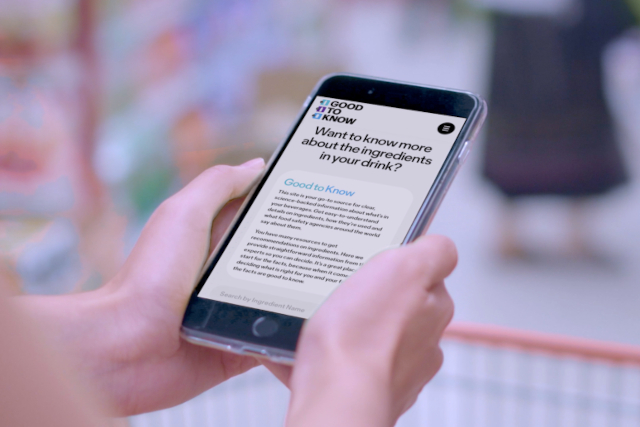
The Big 3 – Coke, Pepsi and Dr. Pepper – are all rolling out new labelling on their fizzy pop products. It’s their response to the American Beverage Association’s (ABA) ‘Good to Know’ initiative… Other brands are expected to follow suit.
‘Good to Know’ what?
The short answer is, ‘what’s in your soda’. But the initiative is more than that. It’s a move to answer growing consumer curiosity – and concern – about the healthiness and safety of what they’re con-suming.
Good to Know is not just a portal to disseminate the data the industry wants you to know. It points users to information from the FDA, the European Food Safety Authority and Health Canada.
“Transparency means more than simply listing ingredients. It means providing relevant context that helps people understand where specific ingredients are used, what function they serve and how reg-ulators in different countries view them,” Kevin Keane, President and CEO of the ABA, explained in a statement.
The new QR codes on fizzy beverages will link to a central ABA database.
A response to the MAHA movement
The Good to Know program is, itself, a response to a call from the Trump Administration for the pro-cessed food industry to be more forthcoming about ingredients.
US Health and Human Services Secretary Robert F. Kennedy Jr. has claimed many additives and other ingredients escape safety reviews by exploiting a loophole allowing manufacturers to ‘self-affirm’ that certain chemicals or additives are ‘Generally Recognized as Safe’ (GRAS).
Under a broader umbrella
The GTK program is actually under a broader umbrella unfurled recently by the US The Consumer Brands Association (CBA), which represents some of the largest food manufacturers in the US. It already maintains a huge database of health and safety information. In fact, it’s expanding its in-gredient database, which consumers can access via a QR code on more than 106,000 participating products from over 1,000 brands.
Just one problem…
There’s just one problem I see with the monumental ingredient info access programs now rolling out across North America. They may list and describe the ingredients, but they don’t address the funda-mental flaw behind the GRAS declaration.
And I, for one, believe most ordinary folks don’t know what GRAS really means.
My take
The whole issue of questionable ingredients in Ultra-Processed Foods (UPFs) is not being addressed by the Good to Know program. Or the CBA database. Consumers need to know what’s good or bad for them, not just what’s ‘in there’.
And that issue is secondary to the main problem: mega-brands introducing ‘upgraded’ products aug-mented, infused and stacked with ‘healthy’ ingredients the social media have trained consumers to want. You can add all the protein, fibre, electrolytes, vitamins and minerals you want… But if you don’t take out the ingredients that make UPFs dangerous and/or unhealthy in the first place, you’re not really improving them…
~ Maggie J.