
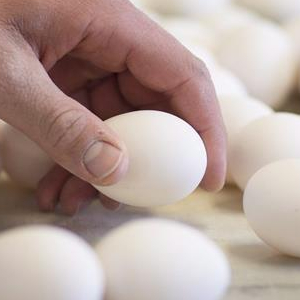
This is exactly the kind of post I’ve been thinking about writing for years. But never got around to… Now, the American Egg Board (AEB) offers essential egg facts in one place! I still have questions about some of their tips. And some additions…
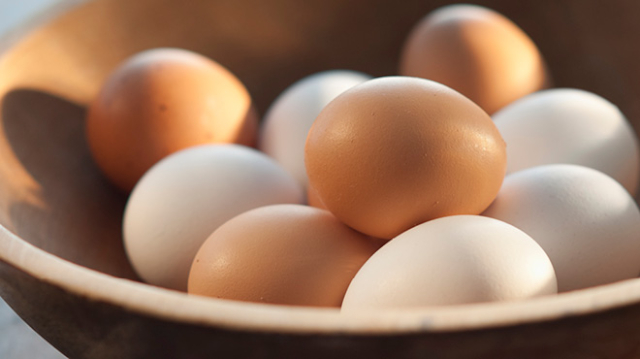
There are a number of salient Egg Facts that you probably don’t know… And a bunch you DO know that are WRONG! See how you do on our Egg Facts ‘Quiz’…
What you don’t know…
… CAN hurt you. Or at least aggravate you, no end. herewith some little nuggets to help broaden your Egg Horizons…
1. Eggs are sized by weight
Bet you thought eggs are sized by their circumferance. Nope. That’s because there’s a range of differ-ence in the volume of the air cell at the top of the egg, inside the membrane that holds the albumin (white). Weight becomes important because eggs are used extensively in baking. And baking is a sci-ence. To a large extent, chemistry. You can’t approximate your ingredients and hope the bread, or cakes or muffins come out right. That’s also why commercial baking recipes, all ingredients are spe-cified by weight. No teaspoons or cups or other volumetric units allowed.
2. Eggs grades DO mean something
Bet you’ve never seen a grade B Egg at the supermarket. That’s because they are only rarely sold at retail. They mostly go direct to commercial bakeries and other outfits that use tremendous volumes of them. One big destination for Grade B is the folks who specialize in liquid eggs – again, intended almost entirely for commercial use.
The Grade of an egg is, in short, a freshness gauge.
“Grade AA eggs have clean, unbroken shells and firm whites, and the yolk stands relatively high,” says Nelson Serrano-Bahri, Chef and Director of Innovation at the AEB. “Grade A eggs are also high quality but may have slightly less firm whites. Both grades are excellent choices for cooking and baking.”
3. Why cracked eggs are bad
As any pro0chef, or even short-order cook will tell you, the Salmonella we all fear so much lives on the outer surface of the egg. Until the egg is cracked. Then it can get into the part we want to use – the albumen and yolk. And that’s just about the most ideal environment a Salmonella bacterium could hope to be blessed with. Always crack your eggs as close as possible as to when you’ll be cooking them. Time is of the essence when bacteria are multiplying…
4. Pasture-raised, free-range, battery
These are the three principle types of housing that laying hens get, depending on the particular pro-ducer they’re ‘working for’. Pastured hens spend the majority of their time outdoors. Free range hens spend some of their time outdoors. And battery hens spend their entire lives indoors, usually in cramped cages, just eating and making eggs.
Chickens that spend any time at all outside are considered to produce better, more flavourful eggs, since they get a chance to eat a wider variety of foods, including what they fins in the ‘field’.
5. Organic vs. ‘regular’
Organic eggs are defined by the USDA as those that meet standards set under the USDA National Organic Program. “These standards include requirements related to feed, outdoor access, healthcare practices, and the use of certified organic ingredients in the hens’ diet,” Serrano-Bahri says.
All organic eggs have come from hens that have at least some access to the outdoors.
6. Omega-3 fortified Eggs
‘Omega-3’ Eggs are made, not just born. All eggs are god sources of Omega-3 fatty acids. But some producers jumped on the Omega-3 bandwagon a few years back, when it was first discovered how good they were for you. To ‘make’ Omega-3 eggs, the farmer feeds his hens a special Omega-3-rich diet which may include ingredients such as flax seed, fish oil, or algae. The eggs these hens make absorb extra Omega-3s as they form , resulting in higher levels of omega-3 fatty acids compared to conventional eggs.
All other nutrient levels, including protein, calories, and most vitamins and minerals remain largely unchanged compared to conventional eggs.
7. Eggs should always be cooked on Medium-Low
As anyone who’s tried frying an egg on High knows, it’s really easy t0 wreck an egg that way. In more ways than one. Eggs cooked at temperatures highre than Medium are constantly in danger of burning, getting rubbery and – most of all – sticking.
There’s no better way to ruin a non-stick pan, or melt a plastic spatula, than frying an egg on High.
The ads always show non-stick pans miraculously producing perfect eggs – fried , scrambled, what-ever – but what they don’t tell you is, those pans are not meant to be used on high heat. Even plain, uncoated pans will turn out great eggs at lower temperatures. And they’ll be stick-free, too, if you just use the right mount of oil, or even butter. My eyes were opened to the secrets of cooking eggs the first time my cooking lab chef-instructor at culinary school demonstrated how to make a perfect, lacy French Omelet. And explained what was happening every step of the way…
And there you have it!
I hope this update on essential egg knowledge and wisdom has made you feel a little more sure of your ability to deal with the beloved Hen Fruit – consistently and successfully!
~ Maggie J.