
Up to about this past year, I always thought ‘functional’ was a modifier indicting whatever it was as-sociated with simply ‘worked’. Now I’m ultra-aware that the term also refers to ingredients in man-ufactured foods that add nutritional value…
We’re talking protein, fibre, pro- and pre-biotics, Omega-3 and -6 fatty acids, collogen and peptides, and ‘biologicals’ such as carotenoids and flavonoids, targeted at specific wellness goals including boosting energy, stamina, and immune support.
Functional coffee?
That’s what Folger’s, the internationally popular coffee brand, is proposing. And they’ve reached the point in their research and development that they have a product ready to roll.
Folgers is now owned by J.M. Smucker’s, the legendary jam and jelly people. And the ‘functional-ization’ of Folgers is just one small part of a big makeover of Smucker’s products to address con-sumer demands – especially from the younger gens – for more ‘substance’ from their beverages.
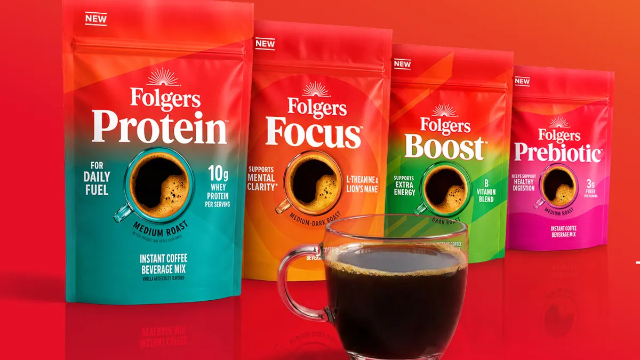
In a first for the Coffee sector, Folger’s is launching 4 new instant coffees, each with a different ‘functional focus’:
Folgers Protein contains 10 grams of added whey protein.
Folgers Focus includes alternative caffeine from L-Theanine and Lion’s Mane Mushroom powder.
Folgers Boost, offers a B-vitamin blend, and…
Folgers Prebiotic includes 3 grams of fiber to promote gut health.
The rationale…
“Functional coffee has generated tremendous interest in the marketplace, but consumers are seeking greater value and simplicity as they consider how it fits into their daily lives,” Emily Lucci, VP of Mark-eting for Coffee at J.M. Smucker, said in a statement.
“This launch is a clear example of our consumer-led strategy in action,” CEO Brad Smucker said in a presentation. “We are taking a trusted leading brand and leveraging its strong equity to participate in emerging consumer trends.”
The new Folger’s coffees are set to roll out at retail in November.
The big picture…
Folger’s – like all the big coffee brands – was hit hard over the past several years, by climate change-induced crop failures and high transportation costs due to the soaring cost of oil.Which combined to drive retail coffee prices up.
Conditions have moderated a little. Smucker’s recently reported a modest 5 percent increase in rev-enues for the fiscal year 2025-2026. But the company is expecting a slight decline in 2026-2027.
Thus, it’s counting on its new functional coffees to attract new, younger coffee drinkers.
My take
First… I wonder if the extreme heat involved in the coffee brewing process degrades at all the fancy ‘functional ingredients’ Folger’s is adding to its new coffees? I was taught at culinary school that ‘cooking’ can break down or otherwise change compounds such as vitamins and biologics…
A recent survey by The National Coffee Association found 66% of American adults drink coffee, with the vast majority of them (83 percent) drinking coffee at home. The trend to at-home coffee con-sumption is widely seen as a reaction to continually increasing take-out coffee prices which appear to have reached a point where a significant number of folks who used to grab a Java on the way to work now have one before leaving home for the commute.
If you’re wondering…
The price you pay for a medium coffee at McDonald’s – still just $1.25 – remains relatively reasonable when compared to other coffee vendors such as Starbuck’s, where a medium plain coffee will cost you as much as $3.35, depending on where you live.
Either way, keep in mind that coffee is one of the cheapest – and highest-profit – menu items at any restaurant. The coffee needed to brew one cup costs the resto about a dime. The paper cup itself costs about 18 cents. And the water isn’t really a consideration. Even if you order a Double-Double, your medium coffee won’t cost any more than about $0.50 to serve.
No wonder more folks are making their own coffee and drinking it at home…
~ Maggie J.