
It isn’t usually the government itself charging that some consumer protection mechanism is ‘broken’, and needs action. But that’s what happened recently at the 2025 Food Safety Summit recently. The FDA, of all groups, admitted its own wheels turn too slowly!
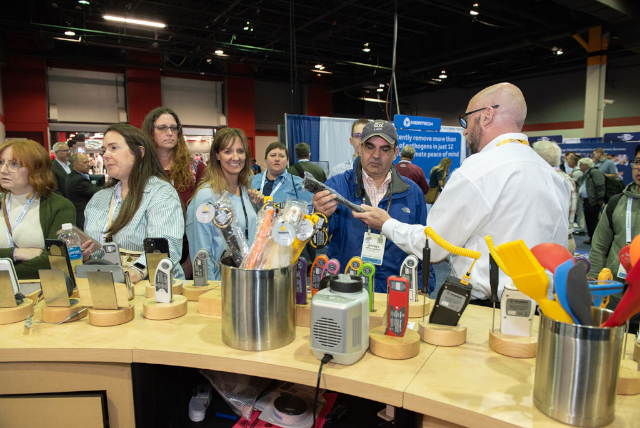 Always an up side: The commercial Expo side of Food Safety Summit 2025
provided positive energy to balance the overall mood of show…
What’s going on?
Sometimes, the FDA alleges, even the most serious recalls take days or even weeks to be classified and issued. Some have literally taken much longer.
Sounds ludicrous, but Hilary Thesmar, Chief Science Officer at The Food Industry Association (FMI) told the Summit, “It takes about three to five weeks to classify a Class I recall. […] In one case, it took almost three years.”
The Summit also heard that the FDA typically posts more than 175 public recall alerts each year, while the U.S. Department of Agriculture (USDA) manages fewer, generally between 30 and 60 annually.
Why?
Good question, apparently. And one that the FDA and USDA can’t answer on their own.
“We have more tools now [then ever before] to reach consumers — and we need to use them better.” Dr. Donald Prater, Principal Deputy Director for Human Foods at the FDA, explained. “Speed and communication are essential,” he continued. “But we also know we can’t do this alone.”
“Getting products off the shelves rapidly — that’s what the whole process is about,” Prater said. But messaging is the primary problem.
“Only 13 percent of Americans have ever visited a government website for food recall information,” Dr. William Hallman, a behavioral scientist and professor at Rutgers University observed. “And just 3 percent are subscribed to emails or text alerts.”
Their own worst enemy
Consumers – who are most likely to benefit by close attention to recall reports – can be their own worst enemy in the current scenario.
Even when notices are received, many consumers don’t take action. Some don’t believe the product is genuinely dangerous. Others simply don’t know how to identify whether what they bought may be dangerous, Hallman told Food & Wine.
A chronic problem is that communications are often purposely vague. The ‘system’ is bound up in concerns about ‘delays, confusing language, legal hedging, and poor visibility of recall notices’, Dr. Darin Detwiler, food safety advocate and author of Food Safety: Past, Present, andPredictions. Official recall notices routinely fall back on ‘qualifying statements’, such as, ‘out of an abundance of caution’ or, ‘no illnesses reported to date’, which can unintentionally downplay urgency.
My take
If I was the FDA or the USDA, my first question – to myself- would be, how do we break the ‘over-caution’ habit? Often it emerges, when we dig into the working guts of organizations – whether small or large, public or private sector – priorities of those with the power to mandate action or make change often focus on covering their own behinds, not making the systems they are in charge of work better – or even in the way they were intended to work in the first place.
Seems to me, THAT’s the major issue causing the Food Recall system’s gears to grind so slowly.
Meanwhile, see the right-hand sidebar on every page of this website for direct links to the major Food Recall websites of the major Powers in the Western world. We’re trying to do our part to keep you informed. But you have reach out and click those links to do yours…
~ Maggie J.