

The more we hear about Ultra-Processed Foods (UPFs), the worse they sound. Now, science has shown that UPFs are linked to no fewer than 1 in 10 avoidable ‘early deaths’. A new study targets such com-mon menu items as fizzy drinks and packaged snacks…
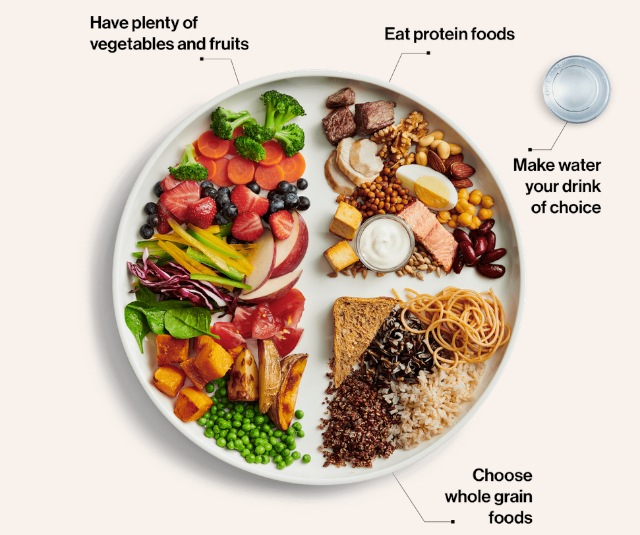 The ideal dinner plate: As recommended by the latest edition of Canada’s Food Guide (2019)…
… But it also places frozen meals and sugary breakfast cereals right up there on the ‘least wanted’ list. Even protein bars, which are commonly portrayed as ‘healthy’ snacks and even healthy meal replacements.
For purposes of the study analysis, researchers defined UPFs generally as: “…ready-to-eat-or-heat industrial formulations that are made with ingredients extracted from foods or synthesized in labor-atories, with little or no whole foods in their composition. These have gradually been replacing traditional foods and meals made from fresh and minimally processed ingredients.”
‘Controllable’ diseases
Brazillian researchers analyzed data from nationally representative dietary surveys and mortality data from eight countries (Australia, Brazil, Canada, Chile, Colombia, Mexico, United Kingdom, and United States).
The study names such common conditions as obesity, type 2 diabetes and dementia among the scourges UPFs can trigger. We knew that. But the surprise comes in the study’s numerical findings.
First, the study – published in the American Journal of Preventive Medicine – reveals that UPFs are associated with an estimated 124,000 ‘controllable’ deaths in the US every year. That’s a full 10 percent of the total.
But more shocking is, researchers have calculated that for every 10 percent of your daily diet that’s composed of UPFs, your risk of untimely death rises by about 3 percent.
Not just a US problem
But the degree to which folks in the surveyed countries rely on UPFs varies widely. Previous surveys have found that average Americans consume more than 50 percent of their daily Calorie intake in UPFs. Some range as high as over 70 percent. And grocery store surveys have confirmed that some 76 percent of the foods on the shelves theses days can be classed as processed of ultra-processed.
Among the least-guilty UPF ‘sinners’ are Colombians, who consume only about 15 percent of their daily Calories as UPFs.
Chain reaction
Study lead investigator Eduardo Augusto Fernandes Nilson of the Oswaldo Cruz Foundation (Fiocruz), Brazil, says: “UPFs affect health beyond the individual impact of high content of critical nutrients (sodium, trans fats, and sugar) because of the changes in the foods during industrial processing, and the use of artificial ingredients, including colorants, artificial flavors and sweeteners, emulsifiers, and many other additives and processing aids.”
So, assessing deaths from all-causes statistically associated with UPF consumption “allows an overall estimate of the effect of industrial food processing on health.”
No excuse
The implied – if not expressed – message is, none of us has any excuse for not improving our daily diet. And it’s well past the time we should have addressed the UPF issue, both as individuals and cultures. The best way to do that is to learn how to identify UPFs before they get into our shopping carts. And substitute in place of them more fresh fruits and veggies, whole grains and plant-based proteins.
“It is concerning that, while in high-income countries UPF consumption is already high but relatively stable for over a decade, in low- and middle-income countries the consumption has continuously increased, meaning that while the attributable burden in high-income countries is currently higher, it is growing in the other countries,” Nilson warns. “This shows that policies that disincentivize the consumption of UPFs are urgently needed globally, promoting traditional dietary patterns based on local fresh and minimally processed foods.”
My take
This new survey is the most pessimistic one we’ve seen yet. And they just underline what we’ve been saying for the past several years, now: Consumers need to me more aware of what UPFs are, and how much damage they’re doing to individuals and populations as wholes.
There’s nothing new about such studies calling for increased government regulation and even legis-lation controlling UPFs and mandating healthier diets.
Alas, efforts in that direction are progressing slowly in the most-developed countries on Nilson’s list. And they don’t appear to be a significant priority in less-developed regions – where they are most needed…
~ Maggie J.