
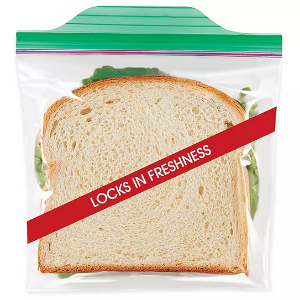
Are Ziploc brand food storage bags ‘microwave safe’? A California resident accusing S.C. Johnson of ‘deceptive advertising’ and ‘misleading representations’, in a class action lawsuit claiming the bags are, ” fundamentally unfit for microwave and freezer use.”
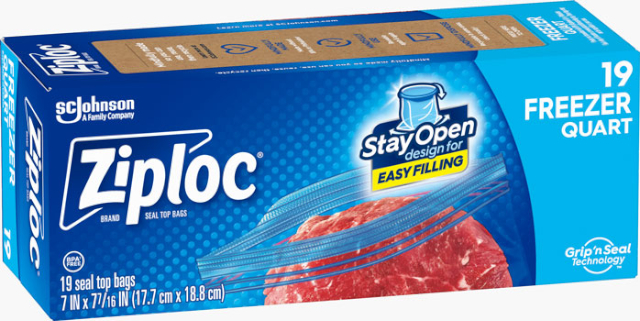
Zip-closure storage containers didn’t exist when I started cooking, at my Mother’s knee. But they appeared pretty quickly thereafter; by the time I was in my teens, as I recall. But now, I don’t think I could cook without them. What was once a luxe convenience is now a necessity.
It’s always something…
What a disappointment to learn that there’s something to be concerned about, even when it comes to a product so inoccuous as a plastic bag.
Linda Cheslow, the nominal filer of the lawsuit, alleges Ziploc bags have the potential to release micro-plastics under ‘extreme temperatures’, such as when they are deep frozen or heated in a microwave. The products in question are kitchen bags made of polyethylene and polypropylene.
The complaint says Ziploc bags and containers are advertised as ‘Microwave Safe’ and suitable for ‘Freezer’ use. And that creates the, “reasonable impression that they are fit for use in the microwave and freezer. […] In reality,” the suit continues, “these products are made from polyethylene and polypropylene — materials that scientific and medical evidence shows release microplastics when microwaved and frozen — making them fundamentally unfit for microwave and freezer use.”
The crux…
A recent Food & Wine report reveals, “Microplastics are defined as tiny plastic pieces less than five millimeters in size. They’re found nearly everywhere — including in the human heart.”
“One study even estimated that 170 trillion plastic particles are floating in the ocean right now. While research on how these microplastics affect us is ongoing (though some studies do show that micro-plastics can damage human cells), it will likely be impossible to avoid all microplastics, no matter how hard you try.”
“Microplastics are currently hard to avoid entirely, as they are present in our food, water, and air,” explains Dr Kelly Johnson-Arbor, a toxicologist at MedStar Health. “We currently do not know the toxic dose of microplastics for the human body, nor do we fully understand how the body absorbs, processes, and eliminates these particles.”
My take
One thing to note” Not all Zip-closure bags are made from polyethylene and polypropylene. Some commercial ‘resealable pouch’ packages are made from other materials. And it’s not the patented closure system that’s bring called into question in the current suit.
Meanwhile… S.C. Johnson has not yet responded publicly to the lawsuit. That’ll be the next chapter in this emerging saga. And we’ll let you know what they have to say when they say it.
What I say is, millions and millions of folks use Ziploc kitchen bags. And the settlement – if Johnson loses the suit – could be a real doozy!
~ Maggie J.