
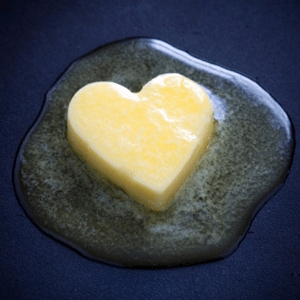
It’s interesting, how this topic comes up over and over again, at fairly regular though widely spaced intervals as time goes by. I’ve come to the conclusion every new generation needs to discover butter + vegetable oil as a cooking combo for itself!
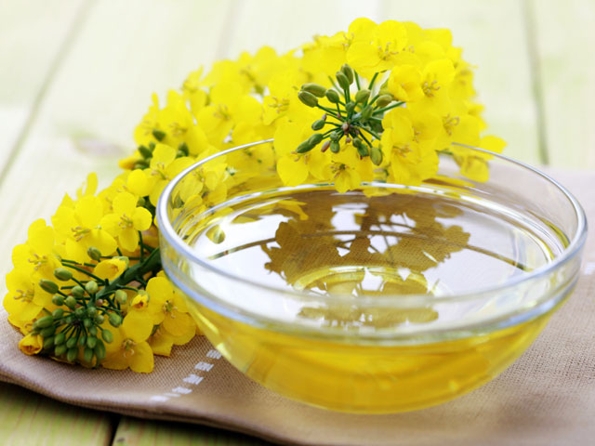 Canola Oil: A perfect partner for Butter in a 50-50 blend, to optimize low-
and medium-temperature frying applications while keeping
cancer and cardio health risks at a minimum!
I remember the first time I ever heard of using part butter butter plus part vegetable oil as a no-stick, relatively healthy combo to pan fry with. It was one of the early ‘welcome to my kitchen’-format, recipe-based cooking shows. I don’t remember who the host was. But I remember the tip!
Butter is ‘too unstable’
The rationale was that pure butter was too unstable to fry with all by itself. But if the food didn’t burn or stick, the flavour of butter was unsurpassed. This was also before I learned (many years later, at culinary school) that you don’t have to use high heat to fry with butter!
The secret, the pros were always happy to divulge, was to replace half the butter you would normally use for a vegetable-based oil with a high smoke point. Such as Canola or sunflower.
Then, as now, it was well-known that butter was prone to burning and/or sticking because its milk solids, which separated from the butter oil upon heating. And olive oil, which was touted as a straight-up substitute for butter in savoury applications, just naturally had an inconveniently-low smoke point fro jobs such as searing or fast frying.
Butter ‘too unhealthy’
But the main issue with butter, especially in later years, was a growing fear that its concentrated saturated fats were a ticket to cardio-compromise.
And then, margarine, a solid form of vegetable fat, was nominated as a frying substitute. But it wasn’t long before we discovered fats that were solid at room temperature were developing dangerously unstable, too, and prone to develop high levels of transfats and triglycerides when subjected to heat.
As collateral damage to that anti-butter ‘discovery’, popular vegetable fats and oils such Crisco were suddenly non-grata in the frying pans of ‘modern’ kitchens. And serious cooks went looking – again – for an ‘ideal’ frying medium.
It was around this time that ag reps (who suggested what oil seed plants farmers should learn to grow), nutritionists and marketing specialists got together and decided rename Rapeseed oil to ‘Canola’, to help it gain traction in the ‘polite’ marketplace. Canola had a high smoke point, added remarkably little of its own flavour to foods, was refreshingly cheap and plentiful, and could be used in a wide range of culinary applications.
Fast forward to today…
Now, many serious cooks often keep a trio of oils right at arms length, at their prep and/or stove-side work stations, in recycled coloured-glass wine bottles with bar-type shot-pouring nozzles affixed to enable controlled dispensing while cooking: Canola for frying, Olive for low-temperature and non-heated applications, and corn oil for baking.
And just recently – as in the past year or so – butter has been coming back, at arms length, under the glass dome of an old-fashioned butter dish. I ran a flurry of posts focusing on how health experts and nutritionists had exonerated butter of much of its stigma and former ‘unhealthy’ reputation as a result of new discoveries about the specific kinds of saturated fats it contains.
Most recently, a new Harvard Medical School study has confirmed that ‘moderate’ butter consump-tion is only marginally less healthy than a complete switch to soy bean or Canola oil…
Specifically:
- A 30-year study of over 200,000 people found that higher butter consumption is linked to an increased risk of early death, particularly from cancer, while plant-based oils are associated with lower mortality rates.
No change, there, in the basic caveats… BUT:
- Researchers estimate that swapping out just 10 grams of butter daily in favour of plant oils could reduce cancer deaths and overall mortality by 17 percent.
Interestingly:
- The findings contradict recent social media claims that seed oils are unhealthy, with experts highlighting the long-term health benefits of replacing butter with plant-based oils in general.
- Plant-based oils are also currently in favour with heart health advocates, physicians and nutri-tionists in that cause-and-effect theatre.
My take
Taken together, the foregoing findings and recommendations point to a perfect confluence of con-ditions for a renaissance of the ancient and venerable oil + butter formula for frying. AT least up ti medium high heat.
Meanwhile, beef tallow is enjoying a reprieve from life in prison (so to speak) at vis à vis frying, after a separate stream of fat research has discovered its specific blend of fats isn’t as horrible as the experts had thought.
And while we’re at it, let’s not forget the ‘butter oil’ school of thought, which advocates separating the butter oils from the milk fats and other solids so as to raise the smoke point of butter while preserving all the subtle flavours serious cooks love.
In parallel with that… Let’s not forget that ancient and venerable Indian Ghee is little more than fermented butter oil. Its health benefits have long been touted. And now, interest is being actively revived in Ghee as a naturally-healthy fermented food!
~ Maggie J.