

It’s more than just a snippet of food trivia. It gets one thinking. About how many times a day we think about food. Specifically, how many food-related decisions we make every day. Now new science claims conventional wisdom has it all wrong…
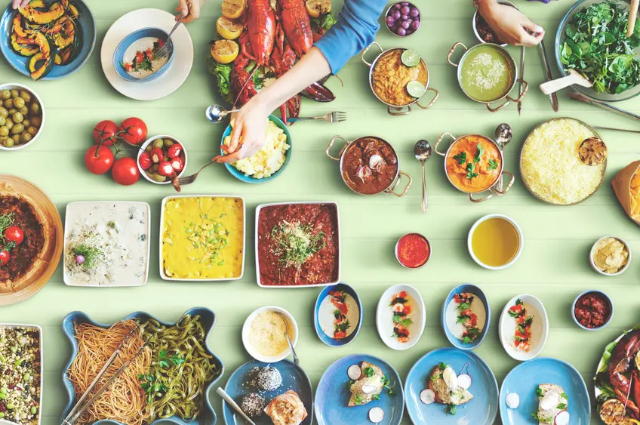 Do we really make more than 200 food decisions per day? Such simplistic
statements can undermine people’s feelings of self-efficacy.
No less an authority than the Max Planck Institute for Human Development (MPI) is challenging the ‘conventional wisdom’, which claims we make around 200 decisions a day about food…
Faulty math?
The ‘conventional wisdom’ is based on a 20-year-old study that resulted in the accepted figure for the average number of daily food decisions we make ballooning from about 14 to something like 226. I’m not a scientist. But I would have instantly questioned the new number, it’s just too much of a change to go unchallenged. And that’s exactly what the MPI team thought.
How they got there
The original 2007 study reached its conclusion by positing that those 14 or so original food decisions were actually made up of collections and sequences of many smaller decisions. They arrived at their 226 number by breaking down the 14 original decisions into their micro-components.
“They asked 154 participants to first estimate how many decisions they made per day about eating and drinking—an average of 14.4,” the MPI study report explains. “Next, participants estimated the number of ‘when’, ‘what’, ‘how much’, ‘where’, and ‘with whom’ decisions they made for a typical meal. These estimations were multiplied by the number of meals, snacks, and beverages they reported consuming in a typical day and summed, giving an average of 226.7 decisions made per day. The [2007] authors interpreted the difference of 212.3 between the two estimates as an indicator of unconscious or ‘mindless’ decisions.”
The ‘subadditivity effect’
MPI researchers, however, suspected that participants in the 2007 study grossly overestimated the number of food decisions they made due to something called the ‘subadditivity effect’.
In the simplest terms, it really doesn’t involve the math of the question, but instead, lies in the tendency of the test subjects to over- or underestimate depending on how the question is asked.
“Such a perception can undermine feelings of self-efficacy,” says MPI team member Dr Maria Almudena Claassen. “Simplified messages like this distract from the fact that people are perfectly capable of making conscious and informed food decisions.”
The takeaway
“So how can decisions about food be meaningfully defined and empirically investigated?” The re-searchers ask. They propose defining food-related decisions in ‘concrete, context-specific terms’.
“What is being eaten? How much? What is being avoided? When? In what social or emotional context? These decisions can only be understood within the context in which they are made. They are based on specific, concrete situations—such as choosing between salad and pasta, or deciding whether to skip a serving.
“What matters most is focusing on the key decisions that align with one’s personal goals: for some-one aiming to lose weight, it might be opting for a light salad over pasta at dinner; for someone striving to eat more sustainably, it could mean choosing a vegetarian meal instead of a meat-based one.”
Opening the door…
Perhaps the most important finding, or recommendation, of the new study is that further research should be conducted, emphasizing different data-gathering and mathematical models, to see how they compare with the 2007 findings.
“Magic numbers such as the alleged 200 food decisions do not tell us much about the psychology of eating decisions, even more so if these numbers turn out to be themselves distorted,” says MPI team member Ralph Hertwig. “To get a better understanding of eating behavior, we need to get a better grasp of how exactly decisions are made and what influences them.”
My take
We’re constantly being told that we need to be more mindful of our food choices and eating behav-iours. Perhaps the MPI study is a solid first step setting us on the right path.
~ Maggie J.