
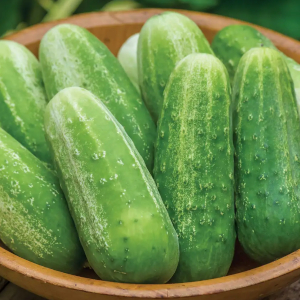
I sometimes get confused – I’ll go as far as to concede, ‘befuddled’ – by stories in the food and main-stream media about how AI is being used in the food industry. But a recent look at how Kraft/Heinz is using AI to make a better pickle cleared up a lot of things for me…
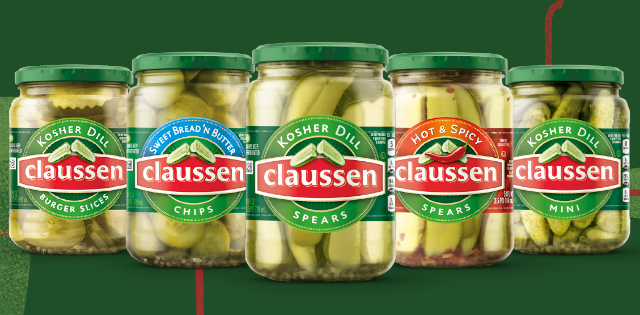
Kraft/Heinz makes a whole slew of refrigerated pickle products under the venerable Claussen’s brand. In fact, Claussen’s s leads its segment of the pickle sector across North America. In it’s drive to preserve that lead, K/H has been phasing in AI over the past year or so, to streamline the evaluation of cucumbers as they enter the plant, and automatically adjust the process from start to finish, to ensure a consistent product.
A green mountain…
Kraft/Heinz turns approximately 60 million cucumbers annually into 42 million jars of Claussen’s. Making refrigeratoed pickles isn’t particularly difficult. But producing the perfect. consistent cucum-ber is nearly impossible. And K/H has to account and adjust for variances of individual cukes con-stantly during its production process.
Add to that that, time is literally of the essence, since the whole process, ‘from vine to brine’, is just 10 days or so. Bill Durbin, the head of North America Logistics and planning at K/H, emphasizes, there’s little room for error.
“With pickles, the circumference matters, the size matters, the length matters, the bend of the cu-cumber, all of those things… Depending on what they are, we will operate differently within the site… [Also] quality. If the quality does not meet our specifications, we can’t run it.”
‘Training’ the AI
Before AI, K/H has to painstakingly train human operators to evaluate the incoming cukes and make minute-to-minuite adjustments along the production line. With AI, they’ve been able to ‘train’ auto-mated systems to evaluate the incoming cukes and make those adjustments without human help.
“We started by bringing in batches of cucumbers, taking pictures of those batches and getting human feedback on which ones [met specifications],” Durbun explains. “We were [manually] training the ma-chine to do that same task.” But it’s much easier with AI on the job. “Now the system is able to iden-tify those things on its own.”
“On pickles, specifically, we’ve seen, since we put this in place, we’ve seen a 12 percent increase in efficiency from that.” Not to mention, “We are getting better quality from the start.”
Opportunities abound…
Durbin says opportunities to employ AI are being identified across the whole vista of K/H products. “[For example], for tomatoes, it’s the size, it’s the color. And so we’re looking at tomatoes, potatoes for Ore-Ida French fries, [etc.] on how we can now scale this [technology] across those other opera-tions”
My take
As consumers, we should be able to discern the effects, the benefits of AI in the products themselves. First and foremost, we should see more-consistent higher-quality products every time we open a bag or jar.
With luck, we should also see prices stabilize or even moderate thanks to savings all along the pro-duction line, as described by Durbin.
We’ll see how it all pans out. But it’s hard to deny that Durbin’s enthusiasm for K/H’s AI is downright infectious…
~ Maggie J.