

An ancient Korean ‘people’s drink may just be the next ‘fresh, new quaff’ on your menu. Influencer and entrepreneur Carol Pak is banking on North Americans loving her fave low-alcohol beverage from back home: makgeolli…
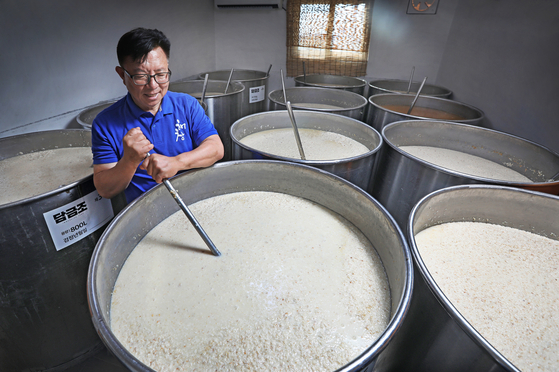 A Korean Makgeolli Master: At work in his neighbourhood ’boutique’ brewery…
Food & Wine contributor Lucy Simon describes Makgeolli as, “a […] fermented rice drink that’s been brewed and consumed in Korea for over 2,000 years.” I immediately thought of the traditional Andean corn beer, Chicha, as a possible distant cousin. Both are considered ‘grassroots’ quenchers, traditionally made by and for the proletariat…
Back to her roots
Online foodie notable Carol Pak made a pilgrimage to her home place in 2017. She was on a quest for a ‘new’ low-alcohol beverage that would stand out from the crowd in the overcrowded North Ameri-can booze market. What she found was Makgeolli.
Wikipedia provides a succinct definition: “It is a milky, off-white, and lightly sparkling rice wine that has a slight viscosity, and tastes slightly sweet, tangy, bitter, and astringent. Chalky sediment gives it a cloudy appearance. As a low proof drink of six to nine percent alcohol by volume, it is often considered a ‘communal beverage’ rather than hard liquor.”
New? Yes – to me, at least. And probably to vast masses of ‘western’ drinkers, as well. But it’s been made and enjoyed for at last 2,000 years on the Korean peninsula.
Why such a secret?
There are some good reasons. Not unlike those that have kept Chicha in the shadows. First, makgeolli is seen as a low-class beverage. It has has always been seen as inferior – in the same way home brew is seen as a poor substitute for commercial beer, and moonshine is considered inferior to real Bourbon. In addition, its cloudy appearance may be considered undesirable, or indicative of contamination.
As Simon neatly sums up: “[Makgeolli] was known for being low quality, […] being sold cheaply in large plastic bottles, and […] causing God-awful hangovers”
Millennial renaissance
Pak relates: “As Korea grew out of poverty, we found influences from abroad, and people didn’t want to be associated with a poor man’s drink.”
Then younger Korean generations seized upon Makgeolli as a beverage of choice – intrigued by its status as a tradition and a cultural icon. And they were also looking for alternatives to conventional mass-market drinks.
That’s led to something of a resurgence of interest in the quaff in it’s homeland. It’s getting a facelift and improved quality control.
The ‘beer’ segment
Makgeolli will find its North American competition in the ‘Beer’ cooler. It’s also a natural option for folks who like hard cider, wine coolers and pre-mixed cocktails. That’s a lot of competition. But it’s also a big market slice for Pak to bite into.
Pak’s company, Sool, is headquartered in New York City. Literally about as far away from Korea as you can get. But she’s found a Korean brewery to make her makgeolli for her. That allows her to retain an ‘authentic’, ‘traditional’ connection.
And as with contemporary domestic Korean makgeolli, her import brand leverages the benefits of clean, healthy ingredients, modern manufacturing and bottling technology, reliable pasteurization, and quality control.
My take
Pak reports business is booming. And she doesn’t know of any commercial competitiors in the North American makgeolli market as yet. But I’ll bet that, if makgeolli becomes as popular as she expects it to be, other brands will pop up like mushrooms after the rain. Then it will be a whole new game.
Until then, good on Pak for having the vision and putting in the work to make it a reality. I’d love to try her product. But it’s not available in my local alcohol regulation jurisdiction – yet…
~ Maggie J.