
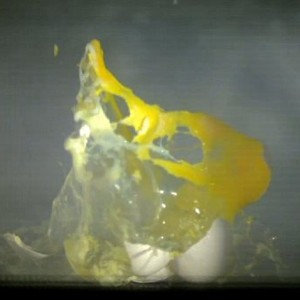
If you don’t clean the interior walls and rotary platform of your microwave oven regularly, you may be risking some ugly food borne illness. The gunk on your mic’s walls may be crawling with germs. And some may even be heat resistant!
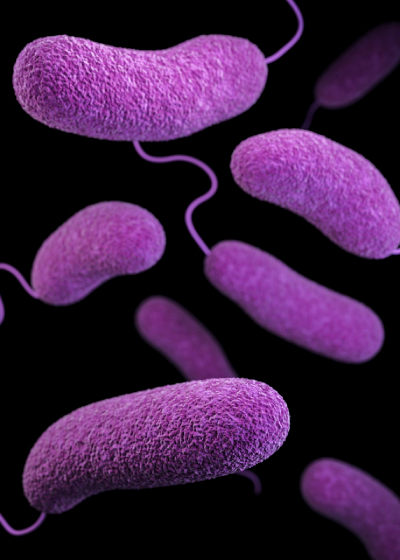 Yuk. It’s definitely a pain to reach inside your microwave and scrub out the spat-ter. But you have to do it regularly, to ensure you’ll remain safe from bacterial contamination.
But there’s steam!
“I thought the heat from freshly mic’d foods kills any bacteria left beind by previous zappings…” I hear you sput-ter. Perhaps. But some bacteria are heat resistant. A few can even survive steam treatment. And don’t get me started on bacterial toxins and viruses…
More serious than you think…
“Microwaves have become an essential part of the modern kitchen, but their potential as a reservoir for bacterial colonization and the microbial compos-ition within them remain largely unex-plored,” warns the preamble to the report on a new study by a multi-institutional team, published recently in the journal Microbiology.
“In this study, we investigated the bacterial communities in microwave ovens and compared the mi-crobial composition of domestic microwaves, microwaves used in shared large spaces, and labora-tory microwaves, using next-generation sequencing and culturing techniques.”
Sounds pretty comprehensive. And it was.
What they found
The team found a staggering total of 747 different kinds of bacteria. Curiously, the types varied by where the microwaves were located.
Home microwaves contained bacteria like Staphylococcus, which can cause a range of infections in people. The kitchen microwaves also had more total microbes than the others. But the microwaves in labs had a more diverse range of bacteria.
No matter how you look at it, the results are shocking. And the fist question that come to my mind is, “How have we all come so far, neglecting the cleanliness of our Microwave ovens, with it catching some really serious ailment?”
How microwaves work
First and foremost, The team stresses that the microbes most likely to contaminate your oven are those that grow in the gunk deposited on its cooking chamber’s walls. Microwaves generate heat by making water molecules in your food dance, rubbing them together.
Alas, the stuff on the walls is not only dryer but older (and more likely to have been micro-colonized over time). And… It’s out of the line of fire. Microwave ovens are designed to concentrate their energy in the middle of the chamber, where the food sits.
“The drier the food, the less likely [it is] to be heated by microwave energy,” explains Ahmed Yousef, Professor of Food Microbiology at Ohio State University. “Even popcorn has some water inside the kernels. Without that water, it would not pop…” In the microwave oven, or anywhere else, for that matter.
How dangerous is residual gunk?
“I would worry about spilled milk, soup, or stew, because these nutritious foods are also good for growing microorganisms,” Yousef says.
However, Dr. Donald Schaffner, a microbial risk assessment and cross contamination expert at Rut-gers University, opines as, “Both Bacillus and Staphylococcus […] need high levels of the microor-ganism to be present before [posing] any significant risk to human health.”
“So, while there is a definite ick factor, the small amount of either bacteria that may be lurking on the walls of your microwave or on the turntable is probably not going to make you sick.
My take
And Schaffner gets the last word: “I’m really not worried about getting my food contaminated from anything that might be inside a microwave.”
Which, in my humble opinion, means, “End of story.” Still, as my kitchen-trolling foodie step-Dad used to say, “Why take chances?”
Just clean it, for crying our loud!
~ Maggie J.