
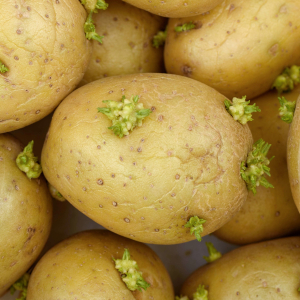
I can vividly recall my Mom cautioning me not to eat sprouted potatoes. “They’re poisonous!” she warned. I lived in fear of them for years. I never actually saw one until I was away from home, living on my own. But by then I knew more…
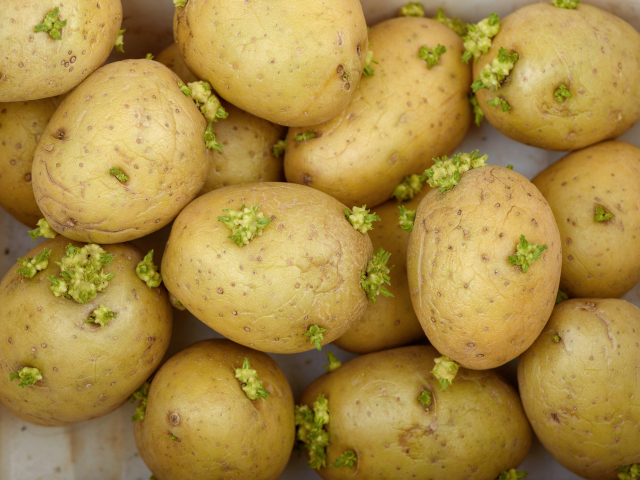
“Store your potatoes in a cool dry place…” That’s the classic – and still valid – advice for handling potatoes after you get them home from the store. And it’s a great procedure to follow if you like to save a little money on spuds by buying them the way we all did in Days of Yore – by the 5 or 10 lb bag.
The McDonalds knew
The brothers who created McDonald’s back in 1940 – Rick and Mac – always credited the uniqueness and superiority of their fries to the way they stored their potatoes. They had special ventilated crates that let air circulate, and kept them in cool, dry, dark places. They didn’t know the science behind it. They just knew that was the optimum way to treat taters.
Now we know
Now we know that potatoes sprout when they’re kept in ideal growing conditions. That is, warm, moist and open to the light. It’s just their nature, literally.
The sprouts are new potato tops trying to grow from the eyes. That’s how potatoes are generally pro-pagated. Anyone who grows their own will tell you the classic way to plant spuds is to cut up whole potatoes into fairly large pieces, each encompassing at least 1 eye. Stick them 4 to 6 in / 10 to 15 cm deep in the ground, 12 to 16 in / 30 to 40 cm apart, with the sprout(s) facing up.
We also know that, no matter how carefully you store your potatoes, the longer you keep them, the more likely they are to sprout. If you give them half a chance.
The eyes have it
… Substances called glycoalkaloids, which are highly toxic. According to the National Capital Poison Center, consuming enough glycoalkaloids can lead to vomiting, abdominal pain, diarrhea, headaches, fever, and in rare cases, even death.
It’s the reason we do eat some root veggie tops including beetroot and carrot, but never tater tops.
As you might expect, the longer and larger the sprouts grow, the more toxic the potatoes, themselves become.
Can you eat sprouted spuds?
The answer is: “Yes” Withy the proviso that the sprouts are still small, the potato itself is still firm and smooth, and it’s not discoloured. If your sprouted spud is dark brown or greenish at all, or wrinkled or mushy, toss it.
The best way to rid your sprouted spud of the bad stuff is to peel it as usual. But then go back and dig out the remaining eye ‘spots’ with a sharp paring knife. Take a fair amount of the margin around each eye (about 0.25 in /3-4 mm), as the sprouts do leech small amounts of toxins locally into the potato flesh.
You can then prep and cook your ‘amended’ potato the way you usually would.
Some caveats…
Older potatoes – though safe to eat – may taste ‘off’ – gamey or musty. They may also develop a woody, fibrous texture that most folks find undesirable. If you’re the least bit in doubt about the wholesomeness or desirability of a potato… Just toss it. It’s not a huge sin. After all, spuds are biodegradable and, as such, are a great asset to any compost pile. And they’re still about the cheapest, yet most nutritious staple food we can eat.
My take
Speaking of which… Many supermarkets are now paying lip service to the concept of making ‘ugly food’ available cheaply for shoppers on the tightest budgets. As we’ve said many times in this space, blemished, off-size, unevenly-ripened produce is just as flavourful and nutritious as the perfect ex-amples grocers like to display – albeit at stratosphereic prices.
The problem has been, and contin-ues to be, that the stores don’t really make an effort to stock a selection of ‘ugly’ produce staples.
On the other hand, the one item my go-to neighbourhood supermarket does stock in ugly abundance is potatoes. You can get classic of white, yellow and sometimes even Russet potatoes for as little as $3 per 10 lb / 4.5 kg bag. That’s a bargain too good to pass up! Especially if you’re feeding a large family (say, 4 or more) and serving spuds on average every second day.
~ Maggie J.