

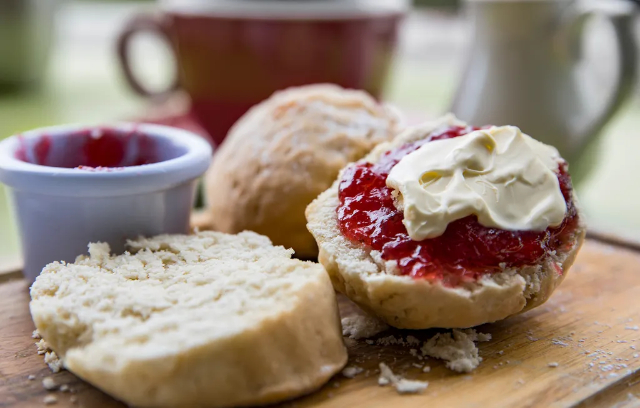
I’m guilty of taking some things in the culinary universe for granted. The things I can do without thinking – or in my sleep. One of those tasks is whipping up a batch of baking powder biscuits or scones. We could probably all do with a refresher!
 Paul Hollywood’s Classic Scone…
Who?
Our chosen scone expert is celeb chef Paul Hollywood. Brits will be nodding their heads in recog-nition. Most everybody else will be blinking in confusion.
“Paul John Hollywood [see photo, top of page] is an English celebrity chef and television personality, widely known as a judge on The Great British Bake Off since 2010,” Wikipedia explains. “Hollywood began his career at his father’s bakery as a teenager and went on to serve as head baker at a number of British and international hotels.”
“You’ll notice [a certain degree of] attention to detail in Hollywood’s judging style,” Food & Wine con-tributor Merlyn Miller points out. “It’s a large part of why audiences tune in, as he carefully spots any flaw in the baked goods he samples on-camera. If you make a mistake, he’ll catch it, and that’s exact-ly what makes him such a skilled baker himself.”
Paul says…
Hollywood recently shared some small but indispensable pointers that will contribute greatly to a more successful scone experience…
Avoid a lumpy mixture
“The crumbly, tender texture of a scone is achieved by rubbing butter into a dry flour mixture, then adding cream or milk to bring the dough together,” Miller summarizes Hollywood’s point. “While American biscuits are typically flaky and can easily separate into horizontal layers, English scones have a finer, more uniform crumb. This is because of how fat is distributed in scone dough: butter coats the flour, preventing gluten strands from forming and making the dough chewy.
“Unlike in a biscuit, butter in a scone is also evenly distributed, so you don’t end up with flaky pockets from evaporated moisture”
Don’t egg-wash the sides of your scones
“If you want to achieve a shiny, golden-brown finish on top of your classic English scones — who wouldn’t? — you’ll likely want to use an egg wash, ” Miller postulates.
“However, Hollywood suggests that you should, ‘egg wash the tops. [But] try not to egg wash the sides. If it goes down the sides too much, it creates a glue and prevents [the scone] from rising up’.”
Adhere to the 15-Minute Rule
In tune with his penchant for perfection, Hollywood prescribes a specific baking time for his classic scones: “Use the 15 minutes of a scone in an oven as a good rule. Fifteen minutes is, 99 percent of the time, going to be spot on.”
He also mandates an oven temperature of 220 C. That’s almost exactly 425 F. So you shouldn’t have any trouble applying that rule.
My take
I never knew the difference between British scones (or tea biscuits) and American biscuits before. It’s an interesting distinction. And I can attest, it really does make a difference in the finished products.
The British version is not only finer-textured, but lighter – especially if you enjoy it fresh from the oven. If it has a chance to cool, the scone will become noticably heavier. And that’s a real shame!
My next scone experiment will be to make a batch to Hollywood’s exacting specifications (linked above). Following his precise instructions to a ‘T’…
~ Maggie J.