
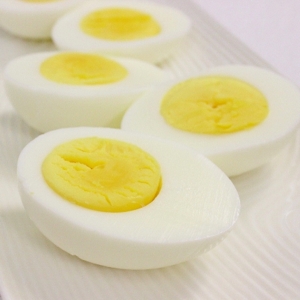
Finally… Something to celebrate a Monday Morning for! Science has developed a technique to produce a perfect hard-boiled egg – every time. It’s a bit fussy, and it takes a little time. But the new technique will enchant egg lovers…
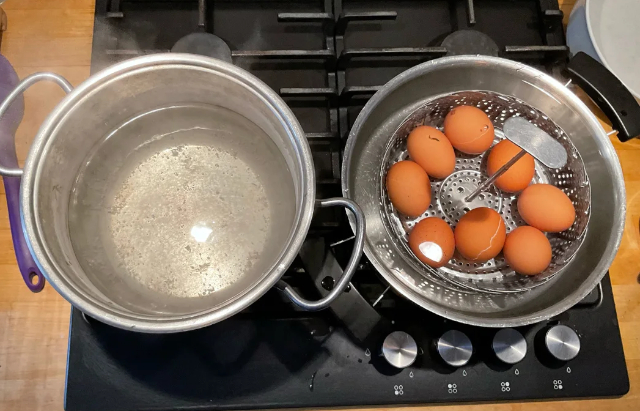 A periodic cooking set-up, with one pot of boiling water andanother at 60 30 °C / 86 °F…
US egg prices are at all-time highs, and egg shortages are in the news daily. It’s the prefect time for science to have discovered a way to produce perfect boiled eggs every time…
Science usually finds a way
In Jurrassic Park, Professor Ian Malcolm (played by Jeff Goldblum) famously says, of a shocking new development: “Nature always finds a way!” I’ll go as far as to assert that, “Science usually finds a way,” to solve any problem, when researchers look long and hard enough.
No exceptions…
Thus it is that – after hundreds of years of trial and error, crackpot theories, pious prayers and ener-getic exhortations… Science has come up with a technique that produces perfect hard-boiled eggs EVERY time.
The first thing I thought when I saw the headline is… “Okay… But how many millions of dollars worth of specialized gear is required? And does the process involve a clean room capable of cooking up the next COVID vaccine?”
I was partly right. A very small part. In fact, one of the best parts of this new discovery is, anyone can duplicate the researchers’ lab-based experiment in their own kitchen with minimal equipment and nothing particularly ‘special’.
The fundamental issue
The main problem with producing a perfect hard-boiled egg is, the albumen (white) and the yolk are very different substances. And it’s a miracle that even the most skilled cook ever gets a boiled egg to come out ‘right’. That’s because the two parts of the egg cook at markedly different rates.
Cooked in one pot, in water at a single temperature – no matter how meticulously maintained – a cook must rely on being able to judge the instant when the inner yolk is perfectly cooked, but the outer albumen hasn’t gone rubbery due to over-cooking.
What they suspected
The researchers determined the optimal temperature at which each part of the egg should be cooked. And they developed a system called ‘periodic cooking’, to distribute periods of variable-temperature cooking over alternating high- and low-temperature sessions, to ensure that neither part of the egg is either over- or under-cooked.
How they managed to do it
“Periodic [method-cooked]eggs were placed alternatively in boiling water (at 100 °C / 212 °F) for 2 min. and water at 30 °C / 86 °F 2 min. Total cooking time was […] 32 minutes, which corresponds to the repetition of the hot and ‘cool’ cooking cycles 8 times,” the Methodology section of the study report explains.
“[A] bowl filled with water kept at 30 °C was used for the cold cooking cycle,” the report says. All eggs used in the experiments were brought to room temperature before cooking.
Following cooking, the eggs were placed under running water to cool quickly, releasing the fully-cooked egg from the inner surface of the shell allowing easy peeling.
What they found
The aforementioned 32 minutes cooking time / 8 cooking cycles produced a perfectly-cooked hard-boiled egg: no runny or underdone yolks; no rubbery albumens; no dark, discoloured layers between the yolk and albumen. Just perfect hard-boiled eggs.
My take
First impression: Yah… This process, and the explanation of why it works, make perfect sense!
Second thought: 32 minutes is a long time to wait for a boiled egg. Even if it is perfect.
Third thought: With eggs costing, on average, twice their usual price in the US, and shortages all over the place, it makes sense to take every precaution not to waste even a single egg through faulty preparation.
And the US Department of Agriculture (USDA) says, you can bulk-cook hard-boiled eggs storing unused ones in the fridge for up to 7 days. Making the extended prep time required by periodic cooking an investment rather than n annoyance.
What egg salad or hard-boiled egg fan would begrudge the effort, considering the amazing results?
~ Maggie J.