

You don’t hear about this much anymore, but Mom always insisted it’s important to remove your wedding rings and other jewelry when cooking. If you scratch glass, it can break spontaneously, contaminating the food with chips and shards…
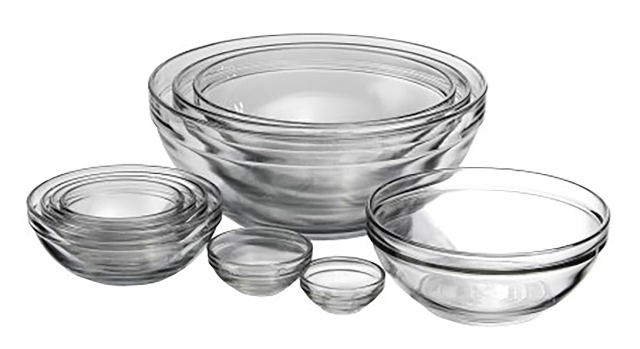 Classic Anchor-Hocking glass mixing bowl set
A little research revealed that this kitchen safety issue used or be a mush more serious concern. And even after specially-treated ‘safety glass’ casseroles and other cooking vessels came into wide use, it remained a wide-spread concern…
The crux of the cracks
When you heat regular glass, it expands, stores up excess energy, and can explode – or just shatter more peacefully – in your hand. Scratches render any glass object even more likely to shatter, along the scratch lines.
That’s also one reason you should never place hot glass objects in, or rinse them with cold water. The shock could crack or shatter them. Likewise, it’s the reason you should always let the dishwasher cool down before even opening the door, even a crack. Just the shock of an inrush of cold air could trigger a glass emergency.
You still see a lot of glassware that’s marked ‘Dishwasher Safe’ or ‘Not Dishwasher Safe’, just to give you the head’s up. And the danger of shock due to thermal expansion is why.
So what’s the deal with scratches?
Have you ever seen them cut a piece of glass to size at the glass and mirror store? They first scratch, or ‘score’ the larger source sheet with a diamond cutter along the line they want to cut. Then they snap off the piece they want by applying a quick tap with the cutter head. It’s not so much a ‘cut’ as a ‘controlled break’.
When you scratch a piece of glass cookware with your engagement diamond or some other piece of jewelry, you are setting it up to break, with very little further ‘encouragement’, the next time even a small amount of pressure or stress is applied to it.
My take
Now the question you’ve all been waiting patiently you ask: “Why is all this so important? Most people cook using plastic implements these days, Right?”
Until a couple of years ago. That’s when the anti-plastic / pro-glass advocates started pushing glass again as safer than plastic. In spite of decades of plastics champions pushing their products as safer because they were much less likely to shatter while in use.
As any experienced cook who’s ever frowned at a tomato-stained Tupperwate storage container will confirm… Plastic is relatively porous. It can easily absorb colours, odours and flavours from foods stored in it. The pro-glass people are also quick to point out, that means plastic can also absorb contaminants and bacteria. Yuk.
Another argument the glass pushers have in their corner is, glass is ‘infinitely recyclable’. It’s ‘sustainability’ is unchallenged – though plastics supporters will point out it takes more energy to remanufacture glassware from recycled material than it does paper or plastic. Which results in a larger carbon footprint. “Yes, but -” you start to say… And that’s just one example of why the glass/plastic merry-go-round keeps on spinning.
The bottom line:
Still others point out that the cooking pros all use unbreakable stainless steel mixing and prep bowls. None of the drawbacks of either glass or plastic. But for the home cook on a budget… Let’s just reflect that they can still get a whole set of glass bowls for the price of one steel bowl. Which is another reason glass remains a home kitchen fave…
Both glass and plastic have their supporters and their detractors. However, with glass coming back into style for food preparation and storage, it’s important that everyone knows why. It’s also why so many glass kitchenware products still carry the warning, “Do Not Use If Scratched Or Chipped’…
~ Maggie J.